Ran the Valley of the Sun 1/2 marathon this morning. Very early this morning. Had to get up at 3am in order to get ready and drive all the way to the edge of town to the race’s staging area near the Usery Mountain park and recreation area. It was beautiful (actually, when I got there, it was very very dark). The race started at 6:15, just as the sun was rising over the desert. I was a bit worried about this race, since my training has been really spotty since the semester started and the last long run I took (10 miles a couple of weeks ago) ended in great pain (the knees, ow). But it went OK, though there were a few hills (some long ones, too). I finished the Rock and Roll ½ marathon in january in 2 hours and 10 minutes about; this one I finished in 2:01:49, so 9 minutes faster. I took 310th place (woo hoo!) and 37th in my division, which I think is age group. And the knees held up.
It’s interesting what people discuss with each other during these long runs. They’re not talking to me, just happen to be on the same pace and nearby; and some people’s voices carry, even when running a half marathon. During part of the January race I was treated to a discussion about someone’s relationship; today I got a half hour of how one person was going to re-do their landscaping and how expensive desert plants from nurseries were these days after the big freeze in January. But a couple of people were talking about the PF Chang run, and reminded me of something I forgot to blog about when I described that run. Over the course of the first two miles or so of that race, there were a number (over a half-dozen) people on the sidewalks holding these huge signs with biblical verses from Revelations and bold warnings that we (presumably the thousands of people trotting down the road) were all on the road to hell (“actually,” someone nearby quipped, “I thought this was the road to Tempe”). It was an interesting way to start a race. No signs today, just lovely saguaro cacti and pretty mountains (and the edge of the ‘burbs cutting into the desert).
Sunday, March 11, 2007

Saturday, March 03, 2007
minivan
Always swore that I'd never buy a minivan.
Never conceived that I'd own a vehicle with leather seats.
And am very wary of built in DVD systems in vehicles.
But with the pragmatics of ferrying small children and their friends thither and yon, the larger vehicle makes sense (seats more people, more car seats). The leather and DVD player just happened to be there, though we weren't looking for them when we were scoping new wheels.
But what prompted such a purchase was the final failure of our ever-faithful 1995 honda civic hatchback (178,000 miles). We loved that car and have driven it across the country, commuted from Georgia to South Carolina in it (cf. the opening of my "home" essay; that's the car). Over the last two years it's been stolen and returned (as part of a police sting operation on a ring of honda thieves no less), wrecked and fixed. Put a new A/C system in it last Spring ($2K) and a new clutch two weeks ago (and new tires last month). But something caused it to overheat, the head gasket blew, the engine fried, and we were looking at way too much money to get it fixed again. But someone who loves those cars bought it and will fix it up so that it may finally make that 200K miles we wanted it to make.
So now we have a 2003 Honda Odyssey in great condition with only 38,000 miles (perhaps they only drove it on weekends?). Not looking forward to having to fill this thing up with gas. But it's a great vehicle.
Never conceived that I'd own a vehicle with leather seats.
And am very wary of built in DVD systems in vehicles.
But with the pragmatics of ferrying small children and their friends thither and yon, the larger vehicle makes sense (seats more people, more car seats). The leather and DVD player just happened to be there, though we weren't looking for them when we were scoping new wheels.
But what prompted such a purchase was the final failure of our ever-faithful 1995 honda civic hatchback (178,000 miles). We loved that car and have driven it across the country, commuted from Georgia to South Carolina in it (cf. the opening of my "home" essay; that's the car). Over the last two years it's been stolen and returned (as part of a police sting operation on a ring of honda thieves no less), wrecked and fixed. Put a new A/C system in it last Spring ($2K) and a new clutch two weeks ago (and new tires last month). But something caused it to overheat, the head gasket blew, the engine fried, and we were looking at way too much money to get it fixed again. But someone who loves those cars bought it and will fix it up so that it may finally make that 200K miles we wanted it to make.
So now we have a 2003 Honda Odyssey in great condition with only 38,000 miles (perhaps they only drove it on weekends?). Not looking forward to having to fill this thing up with gas. But it's a great vehicle.
Friday, February 23, 2007
more on backscatter
New York Times on the launch of backscatter at Sky Harbor (need site registration and allow cookies): http://www.nytimes.com/2007/02/24/us/24scan.html
I went through one of the puff machines they mention in the article at the San Francisco airport last Fall, which was interesting. I'm not interested in volunteering for backscatter.
I went through one of the puff machines they mention in the article at the San Francisco airport last Fall, which was interesting. I'm not interested in volunteering for backscatter.
Wednesday, February 21, 2007
Backscatter X-rays
Our romantically named Sky Harbor airport has been promising to pilot new back-scatter x-ray technology (labelled "the virtual strip-search" by the ACLU) at security checkpoints. The roll-out has been delayed for a while, but it looks like it's back on track and will be operational this weekend.
The Arizona Republic Story: http://www.azcentral.com/news/articles/0221backscatter-ON.html
I've only had the chance to glance quickly at the many responses to the article linked on the website above, but they seem to run the usual gamut of "it's about time, we need to be safe," to "I have nothing to hide, so why should I worry," to "it's a neo-con plot!!" (these are paraphrases, of course).
EPIC (Electronic Privacy Information Center)'s page on backscatter technology:
http://www.epic.org/privacy/airtravel/backscatter/
And the TSA's (Transportation Security Administration) page on privacy and backscatter:
http://www.tsa.gov/research/privacy/backscatter.shtm
Remarkable difference in the level of detail available in the images between the EPIC article (drawing on older reports, presumably) and how the TSA supposedly have tweaked it to reduce the invasion of privacy (down to chalk outlines). One wonders that, given that they're actually doing this, will it actually detect anything useful, and will it detect anything that couldn't be detected by other less intrusive means? It seems to be a solution looking for a problem, another technophilic fix to the problem of security (see David Lyons' Surveillance After September 11; Blackwell).
There's been some concern by the ACLU and others about the fate of these images (who has access, can they be stored, could they end up on the Internet, etc.) According to the TSA (FWIW)--see above link and their link to their FAQ on privacy, scroll to the bottom for backscatter: http://www.tsa.gov/research/privacy/faqs.shtm --
"Images will not be printed, stored or transmitted
To further enhance privacy, when the Transportation Security Officer has resolved any anomaly, the image is erased from the screen. The capability of printing, storing or transmitting the image is not available to the Transportation Security Officer operating the system."
Note that this doesn't say that these images can't be printed, stored, or transmitted, just that the Officer monitoring them can't do this. And note also that the image is erased (passive voice; by whom?) "from the screen." Is it erased from the computer itself? Pick pick pick.
[EDIT: one last thing, almost all of this debate is framed in terms of privacy--which seems obvious since we're talking about taking x-rays of people which see through their clothes. But, again following some of David Lyons' thinking about surveillance, we also need to think this through in terms of other issues, like dignity (a human right according to the UN), and this whole thing certainly seems undignified.
The Arizona Republic Story: http://www.azcentral.com/news/articles/0221backscatter-ON.html
I've only had the chance to glance quickly at the many responses to the article linked on the website above, but they seem to run the usual gamut of "it's about time, we need to be safe," to "I have nothing to hide, so why should I worry," to "it's a neo-con plot!!" (these are paraphrases, of course).
EPIC (Electronic Privacy Information Center)'s page on backscatter technology:
http://www.epic.org/privacy/airtravel/backscatter/
And the TSA's (Transportation Security Administration) page on privacy and backscatter:
http://www.tsa.gov/research/privacy/backscatter.shtm
Remarkable difference in the level of detail available in the images between the EPIC article (drawing on older reports, presumably) and how the TSA supposedly have tweaked it to reduce the invasion of privacy (down to chalk outlines). One wonders that, given that they're actually doing this, will it actually detect anything useful, and will it detect anything that couldn't be detected by other less intrusive means? It seems to be a solution looking for a problem, another technophilic fix to the problem of security (see David Lyons' Surveillance After September 11; Blackwell).
There's been some concern by the ACLU and others about the fate of these images (who has access, can they be stored, could they end up on the Internet, etc.) According to the TSA (FWIW)--see above link and their link to their FAQ on privacy, scroll to the bottom for backscatter: http://www.tsa.gov/research/privacy/faqs.shtm --
"Images will not be printed, stored or transmitted
To further enhance privacy, when the Transportation Security Officer has resolved any anomaly, the image is erased from the screen. The capability of printing, storing or transmitting the image is not available to the Transportation Security Officer operating the system."
Note that this doesn't say that these images can't be printed, stored, or transmitted, just that the Officer monitoring them can't do this. And note also that the image is erased (passive voice; by whom?) "from the screen." Is it erased from the computer itself? Pick pick pick.
[EDIT: one last thing, almost all of this debate is framed in terms of privacy--which seems obvious since we're talking about taking x-rays of people which see through their clothes. But, again following some of David Lyons' thinking about surveillance, we also need to think this through in terms of other issues, like dignity (a human right according to the UN), and this whole thing certainly seems undignified.
Thursday, February 15, 2007
CSPO
Just became an affiliate faculty member of the Consortium for Science, Policy & Outcomes, a unit run out of the College of Liberal Arts and Sciences of ASU down in Tempe. Seems an interesting group of folks, lots of potential for collaboration at some point. I'll be presenting a brown-bag lecture down there later this Spring just as a means of introduction. CSPO is also affiliated with the Center for Nanotechnology in Society, and nanotech has been a long-time interest of mine (though I've never had the opportunity to write about it yet).
Sunday, February 11, 2007
5K
Just ran my first 5K in donkey’s years. After the half marathon the 3.1 miles should be a piece of cake, but a 5K is more about strength and speed than endurance. Anyway the run kinda sucked (well, my run did, the entire event—The Year of the Boar 5K Run and Wok—was a convivial and efficient, though relatively small, affair). Not sure what went wrong. First mile was fast-ish (7:16, which is fast for me these days), but hit something like a bloodsugar drop on the second mile and lost energy (hit mile 2 in 15 minutes, so not too much slower), which led to general nausea in the third mile (fun, eh?). So I ended up with a 24:00 5K and still managed to win my age group (!). Which goes to show both that it pays to be over 40 and also how small an event this was.
Now, 24 minutes is a pretty decent time. But I’m also realizing as I do more of these events that my only yardstick of success for distance running—and hence my real competition—is what I did when I was 18. I know, I know: competing with oneself is such a cliché. But I also have this nagging feeling that I can actually beat him (that is, me, or the 18-year old me): I’m handling distances much more easily than I did when I was younger. I should point out that when I was 18, I wasn’t that great a runner and never made varsity in either track or cross-country, so it’s not like I’m setting the bar all that high here.
Now, 24 minutes is a pretty decent time. But I’m also realizing as I do more of these events that my only yardstick of success for distance running—and hence my real competition—is what I did when I was 18. I know, I know: competing with oneself is such a cliché. But I also have this nagging feeling that I can actually beat him (that is, me, or the 18-year old me): I’m handling distances much more easily than I did when I was younger. I should point out that when I was 18, I wasn’t that great a runner and never made varsity in either track or cross-country, so it’s not like I’m setting the bar all that high here.
Tuesday, February 06, 2007
New books
Looks like I need to find a new phrase to begin my blog posts :)
Two new books:
David Harvey, A Brief History of Neoliberalism (Oxford)
Manuel DeLanda, A New Philosophy of Society: Assemblage Theory and Social Complexity (Continuum).
The latter has me wondering about what seems to be a sudden recent interest in Deleuze's (and D&G's) notion of assemblage. I have a vested interest in this, of course, having written a chapter in Charles Stivale's Gilles Deleuze, Key Concepts book on Assemblage and using it in my own work on technology (first in Exploring Technology and Social Space, and then more extensively in Jennifer and my Culture and Technology: A Primer). But there's not only DeLanda's new book and essay ("Deleuzian Social Ontology and Assemblage Theory" in Fuglsang and Sorensen's Deleuze and the Social) and his previous book, Intensive Science and Virtual Philosophy, but three separate essays on assemblage in last year's Theory, Culture and Society's mammoth special issue on Problematizing Global Knowledge. Also the term comes up in the title of Ong & Collier's edited collection, Global Assemblages: Technology, Politics, and Ethics as Anthropological Problems (Blackwell), though it's really not developed at all in the collected itself.
Anyway, I'm interested to read at least the first couple chapters of DeLanda's book, his explication of assemblage. I'm more wary of the latter chapters applying the theory to society and social problems, especially after the entry in The Pinocchio Theory blog on the book and an excellent but as yet unpublished essay by Steven D. Brown on Deleuze and social science which I just got the chance to read.
Two new books:
David Harvey, A Brief History of Neoliberalism (Oxford)
Manuel DeLanda, A New Philosophy of Society: Assemblage Theory and Social Complexity (Continuum).
The latter has me wondering about what seems to be a sudden recent interest in Deleuze's (and D&G's) notion of assemblage. I have a vested interest in this, of course, having written a chapter in Charles Stivale's Gilles Deleuze, Key Concepts book on Assemblage and using it in my own work on technology (first in Exploring Technology and Social Space, and then more extensively in Jennifer and my Culture and Technology: A Primer). But there's not only DeLanda's new book and essay ("Deleuzian Social Ontology and Assemblage Theory" in Fuglsang and Sorensen's Deleuze and the Social) and his previous book, Intensive Science and Virtual Philosophy, but three separate essays on assemblage in last year's Theory, Culture and Society's mammoth special issue on Problematizing Global Knowledge. Also the term comes up in the title of Ong & Collier's edited collection, Global Assemblages: Technology, Politics, and Ethics as Anthropological Problems (Blackwell), though it's really not developed at all in the collected itself.
Anyway, I'm interested to read at least the first couple chapters of DeLanda's book, his explication of assemblage. I'm more wary of the latter chapters applying the theory to society and social problems, especially after the entry in The Pinocchio Theory blog on the book and an excellent but as yet unpublished essay by Steven D. Brown on Deleuze and social science which I just got the chance to read.
Wednesday, January 24, 2007
Copenhagen, part II
Looks like I'll also be making a presentation that same trip to Copenhagen University, courtesy of the Anthropology Department (thanks to Kare Jansbol for the invite!). It'll be a more general talk on Deleuze and Technology, that Thursday afternoon (May 10th).
Friday, January 19, 2007
Copenhagen
Looks like I'm going to Copenhagen in May. I've been invited to participate in a short, intense PhD seminar at the IT University of Copenhagen along with Adrian Mackenzie, Casper Bruun Jensen, and Steve Brown. The website for the course is here: http://www1.itu.dk/sw55657.asp in case anyone knows of any PhD Students who would be interested in taking the course. It's on Deleuze, Technology, and Ethnograpy. My thanks to Soren Mork Petersen for the invite.
In any case, I'm looking forward to it. Need to start working on my presentation, most likely something around Deleuze, technology, assemblage, attention, and ubiquitous computing (everyware) which I'm hoping to turn into either a long essay or a short book (though all my plans for long essays always turn into very short essays for some reason).
Now, if I could get that Danny Kaye song out of my head, I could think things through more clearly :)
In any case, I'm looking forward to it. Need to start working on my presentation, most likely something around Deleuze, technology, assemblage, attention, and ubiquitous computing (everyware) which I'm hoping to turn into either a long essay or a short book (though all my plans for long essays always turn into very short essays for some reason).
Now, if I could get that Danny Kaye song out of my head, I could think things through more clearly :)
Monday, January 15, 2007
More on the half-marathon
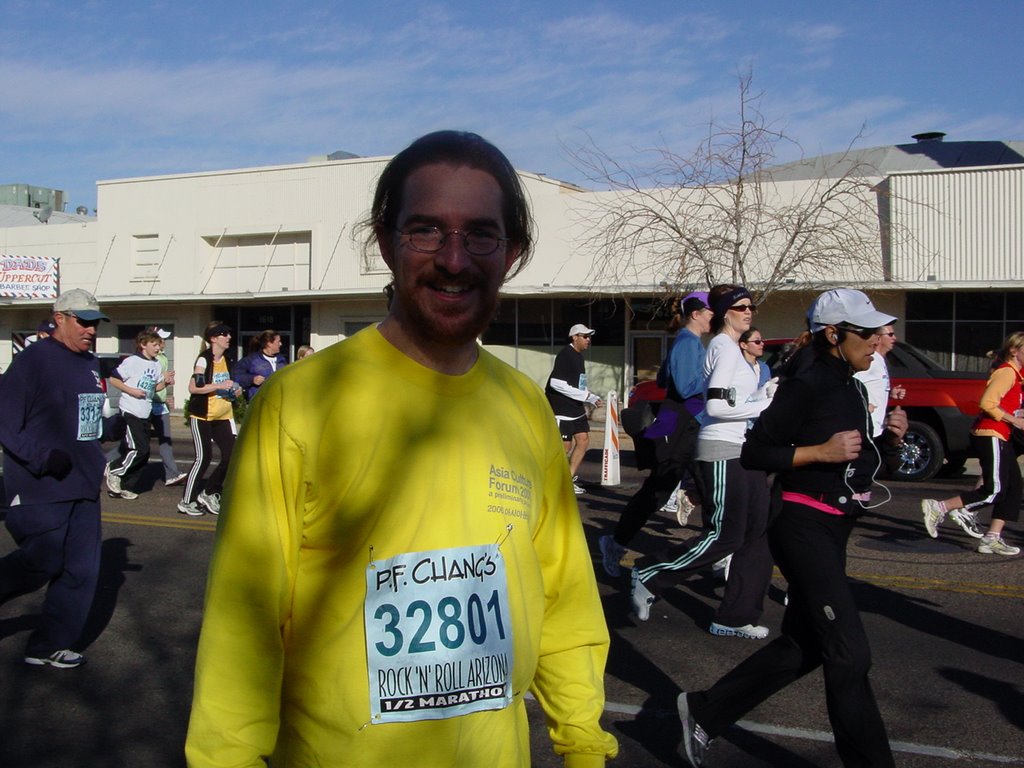 This is me between miles 4 and 5 having just dropped off my jacket, hat, and gloves with Elise. Only 8 or 9 miles to go! Note the Asia Culture Forum T-Shirt (see previous postings in this here blog).
Sunday, January 14, 2007
Half Marathon
Just a quick blog. This morning I ran the PF Chang’s Rock and Roll Half Marathon here in Phoenix. I’ve only run a race close to this distance (a 20K) once, and that was back in the first Reagan administration. For some reason I’ve been able to sustain these longer runs over the last few months (ah, sabbatical). In any case, 13.2 miles is my longest race, and probably my longest run. I was looking to finish, hoping to hit a pace of about 10 minutes a mile, and ended up just about there, finishing in 2:10:45 (which would be a world class time—in the marathon). So I’m happy.
It was coooooold today in Phoenix—lows in the mid 20’s F and temps perhaps at the mid-30s at race time. I started slow, taking it easy, and seeing how the whole thing felt. Actually ended up taking a pit stop at the portable johns at the first mile mark since they kept us standing at the start in the cold for over 45 minutes, and I had been drinking lots of coffee. But after about 6 miles or so I felt pretty good and started picking up the pace, and from then on basically ran negative splits (each mile faster than the previous). Ended up feeling really great over the last 3 miles. I’ll post pictures when I get them.
There were over 37,000 registrants for both the marathon and half-marathon today, not sure how many stayed home because of the cold, but there were tens of thousands of people out there on the course today. Runs are usually fairly festive events, but this one prides itself on its entertainment—bands (mostly rock—and if I hear “Born to be Wild” one more time….You think these bands would know another song) every other mile or so, cheering squads along the route. What I do like about road racing (and this was my first road race since….um….the second Reagan administration, perhaps the first Bush admistration) is that transgressive feeling you get running down the middle of the street (where only cars are supposed to go) ignoring all the stop signs and stoplights.
Anyway, I’m sleepy, my feet are tired, and my knees ache.
But there’s another ½ marathon down in Mesa in two months…
It was coooooold today in Phoenix—lows in the mid 20’s F and temps perhaps at the mid-30s at race time. I started slow, taking it easy, and seeing how the whole thing felt. Actually ended up taking a pit stop at the portable johns at the first mile mark since they kept us standing at the start in the cold for over 45 minutes, and I had been drinking lots of coffee. But after about 6 miles or so I felt pretty good and started picking up the pace, and from then on basically ran negative splits (each mile faster than the previous). Ended up feeling really great over the last 3 miles. I’ll post pictures when I get them.
There were over 37,000 registrants for both the marathon and half-marathon today, not sure how many stayed home because of the cold, but there were tens of thousands of people out there on the course today. Runs are usually fairly festive events, but this one prides itself on its entertainment—bands (mostly rock—and if I hear “Born to be Wild” one more time….You think these bands would know another song) every other mile or so, cheering squads along the route. What I do like about road racing (and this was my first road race since….um….the second Reagan administration, perhaps the first Bush admistration) is that transgressive feeling you get running down the middle of the street (where only cars are supposed to go) ignoring all the stop signs and stoplights.
Anyway, I’m sleepy, my feet are tired, and my knees ache.
But there’s another ½ marathon down in Mesa in two months…
Friday, December 29, 2006
addendum
Add Thomas Pynchon's Against the Day to the list.
However, I'm still slogging my way through Mason & Dixon (just passed 100 pages) and haven't read Vineland yet.
However, I'm still slogging my way through Mason & Dixon (just passed 100 pages) and haven't read Vineland yet.
Wednesday, December 20, 2006
New Books
Big stack of new* books piling up over the last few weeks. Wish I had the time to read all these before the semester starts up in January. Just a quick list for now:
Melissa Gregg, Cultural Studies’ Affective Voices. Palgrave
Andrew Feenberg, Transforming Technology: A Critical Theory Revised. Oxford
John Lienhard, The Engines of Our Ingenuity: An Engineer Looks at Technology and Culture. Oxford.
John Lienhard, How Invention Begins: Echoes of Old Voices in the Rise of New Machines. Oxford. [includes a section on the invention of the printing press; perhaps a different angle on a story told well be Elizabeth Eisenstein]
Michael Sheringham, Everyday Life: Theories and Practices from Surrealism to the Present. Oxford.
Shaun Moores, Media/Theory: Thinking about Media and Communications. Routledge
Gary Hall & Clare Birchall (Eds) New Cultural Studies: Adventures in Theory. Edinburgh UP [OK, I have a chapter in this one on Rem Koolhaas]
Gerard Goggin, Cell Phone Culture: Mobile Technology in Everyday Life. Routledge.
Richard Lanham, The Economics of Attention: Style and Substance in the Age of Information. Chicago.
Janne Seppanen, The Power of the Gaze: An Introduction to Visual Literacy. Peter Lang
Anandam Kavoori & Noah Arceneaux (Eds) The Cell Phone Reader: Essays in Social Transformation. Peter Lang.
Bruno Latour, Reassembling the Social: An Introduction to Actor-Network Theory. Oxford. [returning the library copy]
*New=I just got them, not necessarily new releases
Melissa Gregg, Cultural Studies’ Affective Voices. Palgrave
Andrew Feenberg, Transforming Technology: A Critical Theory Revised. Oxford
John Lienhard, The Engines of Our Ingenuity: An Engineer Looks at Technology and Culture. Oxford.
John Lienhard, How Invention Begins: Echoes of Old Voices in the Rise of New Machines. Oxford. [includes a section on the invention of the printing press; perhaps a different angle on a story told well be Elizabeth Eisenstein]
Michael Sheringham, Everyday Life: Theories and Practices from Surrealism to the Present. Oxford.
Shaun Moores, Media/Theory: Thinking about Media and Communications. Routledge
Gary Hall & Clare Birchall (Eds) New Cultural Studies: Adventures in Theory. Edinburgh UP [OK, I have a chapter in this one on Rem Koolhaas]
Gerard Goggin, Cell Phone Culture: Mobile Technology in Everyday Life. Routledge.
Richard Lanham, The Economics of Attention: Style and Substance in the Age of Information. Chicago.
Janne Seppanen, The Power of the Gaze: An Introduction to Visual Literacy. Peter Lang
Anandam Kavoori & Noah Arceneaux (Eds) The Cell Phone Reader: Essays in Social Transformation. Peter Lang.
Bruno Latour, Reassembling the Social: An Introduction to Actor-Network Theory. Oxford. [returning the library copy]
*New=I just got them, not necessarily new releases
Wednesday, November 29, 2006
High Tech Trash, Part II
Got a link to Chris Jordan's website from Anne Galloway's blog. Fascinating images, disturbing, and yet a bit too pretty in some ways.
Tuesday, November 28, 2006
That accent...
What accent?
Got this link from Gil, who evidently sounds "Southern" (coulda fooled me, though).
| What American accent do you have? Your Result: The Midland "You have a Midland accent" is just another way of saying "you don't have an accent." You probably are from the Midland (Pennsylvania, southern Ohio, southern Indiana, southern Illinois, and Missouri) but then for all we know you could be from Florida or Charleston or one of those big southern cities like Atlanta or Dallas. You have a good voice for TV and radio. | |
| The West | |
| Boston | |
| North Central | |
| Philadelphia | |
| The Northeast | |
| The South | |
| The Inland North | |
| What American accent do you have? Take More Quizzes | |
Got this link from Gil, who evidently sounds "Southern" (coulda fooled me, though).
Tuesday, November 21, 2006
"Ear Worms"
Gil has been talking about having Billy Joel's "An Innocent Man" stuck in his head the last few days. Which reminded me of a blog I never posted from last Fall. Seems appropos.
--------------
I've had Jimmy Buffet's "Come Monday" stuck in my head for going on 4+ days now, with only occasional breaks for other similarly audio-sticky songs. What was an amusement is rapidly becoming much less so. But I figured if I can infect others with the Buffet audio meme, then perhaps it will go away and leave me in peace. So enjoy.
Part of the problem was that I was just down in San Antonio, where I went to undergrad, and Jimmy Buffet tunes were standards of the various singer/songwriters on campus an the surrounding hangouts when I went to school. So the atmosphere helped maintain the presence of the tune in my head. Maybe now that I'm back in Phoenix that'll help.
--------------
I've had Jimmy Buffet's "Come Monday" stuck in my head for going on 4+ days now, with only occasional breaks for other similarly audio-sticky songs. What was an amusement is rapidly becoming much less so. But I figured if I can infect others with the Buffet audio meme, then perhaps it will go away and leave me in peace. So enjoy.
Part of the problem was that I was just down in San Antonio, where I went to undergrad, and Jimmy Buffet tunes were standards of the various singer/songwriters on campus an the surrounding hangouts when I went to school. So the atmosphere helped maintain the presence of the tune in my head. Maybe now that I'm back in Phoenix that'll help.
Saturday, November 04, 2006
Asia Culture Forum
Despite what this says above, I'm posting this on 11 Nov., 2006.
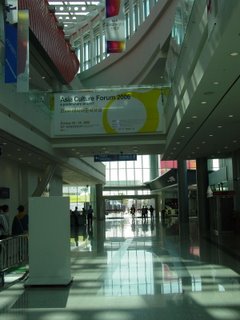
So, I made it to Korea and back. It was a great trip. I was worried because in the days before I left a cold front had come through Phoenix and my allergies had really kicked up. So I went into the trip with a sore throat &c, which is usually how I come back from trips. But I ended up feeling great.
I flew United from Phoenix to San Francisco, then San Francisco to Incheon (12 hours: I napped a bit, read some of Donald Norman's book The Invisible Computer and pieces of his Emotional Design book, and tweaked my presentation; watched "Click" on the small screen TV in the seat; drank loads and loads of green tea). My itinerary had me landing at Incheon airport then not just changing planes, or terminals, but entire airports—taking a bus to the old Gimpo airport in Seoul (which is the one we used to fly into and out of when I was a kid). I was told that the bus ride took about 30 minutes, but to allow an hour just in case. Of course, we were late leaving San Francisco, and so late into Incheon, then we taxied for EVER, and then waiting for my bags so I can go through customs. It’s late on a Friday night and I know this is the last plane down to Gwangju. I start playing with ideas of renting a car and driving through the night to get there for my morning plenary talk (though I don’t read Korean and have no idea where I would be going). An hour before my flight is to leave Gimpo I pass through customs and immigration at Incheon, head straight to the transportation desk down in the lobby (which I remember from a previous trip in 2002), get a ticket and the next thing I know I’m in the last seat on a warm, airless bus heading into Seoul. Traffic, surprisingly, is light and before I know it we’re at Gimpo. I get my boarding pass, make my way through security, and end up at the gate 10 minutes before we even start boarding.
On the flight I have a nice conversation with an orthopedic surgeon who has just been to a conference in Seoul and is heading back home. The flight is all of 35 minutes (I keep forgetting how small a country this is). Then I’m in a cab and off to the Hiddink Intercontinental Hotel (recently renamed in honor of the Korean national football team coach). I check in to my suite and the porter shows me how things work. For one thing, I have two front doors, two bathrooms, one bedroom, and a sitting room. One places the key in a slot by the door when you come in and that turns out the lights (take it out to leave and the power goes off to everything). Most of the orientation is to the three remote controls. One is for the heating unit, one is for the A/C unit, and one handles the TV and lights and some other things I never figured out.
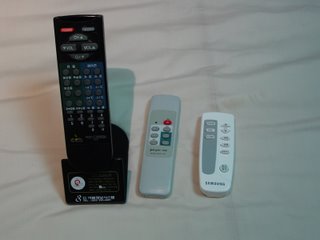
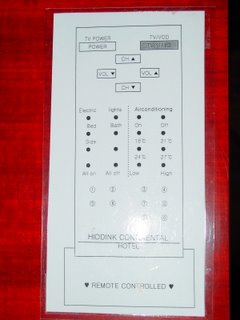
I’m supposed to call Shin Dong Kim when I get it, but I can never figure out the phones. So I get the front desk to call him for me; he and others are at a restaurant a ways away. Since it’s quite late and I have to speak in the morning, I excuse myself from joining them, set a time to meet him for breakfast, and head up to the suite to flip through the channels and fall asleep. There is a channel devoted to the game “Go,” another which seems to be just watching someone playing a videogame, another which is dedicated to US reality TV shows, and many many others, including music videos, game shows, dramas, films.
Early the next morning I get ready and head up to the restaurant for breakfast. I thought I was to meet Shin at 7:15 but he doesn’t arrive. I chat with some other folks from the conference. By 7:50 they’re moving people to the bus to take them to the convention center, so I go along. The bus is delayed, though I don’t know why, and we arrive about 10 till 9:00 (my talk is at 9). I meet up with Shin, who says that there was a miscommunication and that he was going to take me to the convention center in a cab. Anyway, apparently the party at the restaurant had gone very late (2am or so) and so people are very slow arriving. We decide to delay my talk until we can get a decent crowd, and so get started at 9:20. I had an hour to talk, now it’s down to 40 minutes (since there’s a panel right at 10). I talk fast, editing on the fly as I try to hit the high points, and most likely frustrated the hell out of the simultaneous translators (my apologies to them, since I know that is hard work in the best of circumstances). It’s quite a pan-Asian crowd. I answered some questions, and then was done. Chatted with folks a bit more in the hall outside, especially a very eager Korean graduate student. And then talked with Shin about mobile visual technologies (he borrows a grad student’s cell phone and shows me how it can play live television). Later I get a chance to look through all the conference materials, purchase the proceedings (several volumes), and then meet up with Keehyeung Lee, who I went to grad school with. Keehyeung, Shin, and I and others get lunch in a great local restaurant housed in the convention center. Apparently Gwangju is known for its food, which was wonderful. There is a local specialty which is a very strong smelling fish, and apparently few outside that region of the country like it. I ate a piece, which took a lot of chewing, and wasn’t, uh, problematic until I was almost done, when it became pretty overpowering. But I finished it nonetheless.
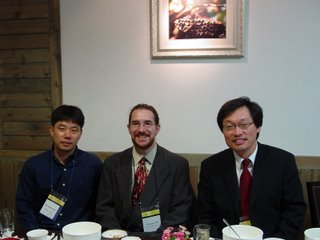
Keehyeung Lee, Me, Shin Dong Kim
That afternoon I went to a couple of panels, drank coffee (since the trip was beginning to hit me), did an interview for a local news website, and then caught a bus to the city center where they had a Youth Culture night with live entertainment and really great food. Run into Kuan-Hsing Chen briefly. Talk with folks doing mobile media research. Then walk back to the hotel where Shin commandeers the dining room for beer and karaoke for conference folk. Late (and no, I didn’t sing), I call it a night and head back to my suite.
The next morning (feeling not a bit of the allergies I arrived with), Sunday, reversed the process. Breakfast in the hotel (a buffet: rice, seaweed, corn, eggs, bacon, sausage, toast, seaweed soup, kimchee, green salad, cold cereal, muffins, orange juice, coffee, tea). Then a cab to the airport, plane to Gimpo, bus to Incheon, do some last minute shopping in the airport (picked up T-shirts for the kids, a couple of tea cups for Elise, and two CDs for me: the latest Crying Nut and Rollercoaster), and then it’s a 10-hour flight back. I slept most of the way, and still managed to read Steven Johnson’s Everything Bad is Good for You and watch Keanu Reeves and Sandra Bullock in The Lake House. A Scanner Darkly was also on, but the audio quality of those headsets was such that I promised myself to rent it later since I’d miss too much of the film. The flight back corresponded with Saturday night, and so I woke up and landed early in the morning on Sunday (again) in San Francisco. Then a flight back to Phoenix. And no discernible jet lag.
Of course, then Monday evening I had to give a talk on surveillance to a community group, so little time to rest.
All in all, a quite rewarding trip. It was great to be invited and given the opportunity to present a paper. My thanks, again, to Shin Dong Kim for inviting me. Great to meet new folks, see some old friends. My paper is online at their website.
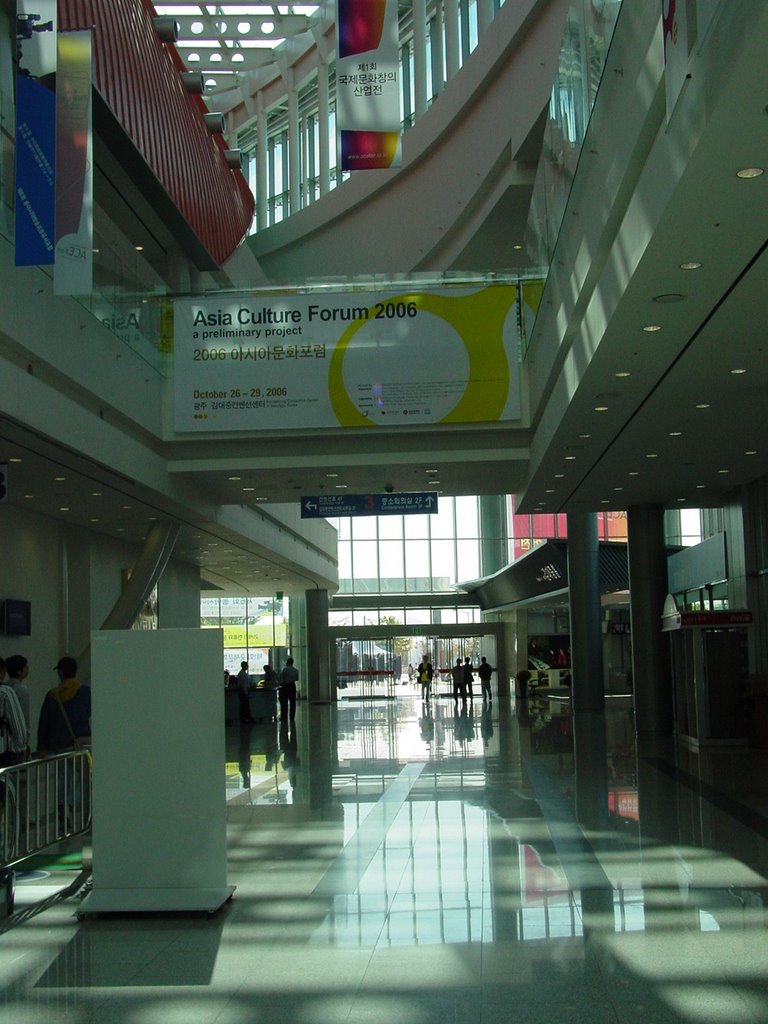
So, I made it to Korea and back. It was a great trip. I was worried because in the days before I left a cold front had come through Phoenix and my allergies had really kicked up. So I went into the trip with a sore throat &c, which is usually how I come back from trips. But I ended up feeling great.
I flew United from Phoenix to San Francisco, then San Francisco to Incheon (12 hours: I napped a bit, read some of Donald Norman's book The Invisible Computer and pieces of his Emotional Design book, and tweaked my presentation; watched "Click" on the small screen TV in the seat; drank loads and loads of green tea). My itinerary had me landing at Incheon airport then not just changing planes, or terminals, but entire airports—taking a bus to the old Gimpo airport in Seoul (which is the one we used to fly into and out of when I was a kid). I was told that the bus ride took about 30 minutes, but to allow an hour just in case. Of course, we were late leaving San Francisco, and so late into Incheon, then we taxied for EVER, and then waiting for my bags so I can go through customs. It’s late on a Friday night and I know this is the last plane down to Gwangju. I start playing with ideas of renting a car and driving through the night to get there for my morning plenary talk (though I don’t read Korean and have no idea where I would be going). An hour before my flight is to leave Gimpo I pass through customs and immigration at Incheon, head straight to the transportation desk down in the lobby (which I remember from a previous trip in 2002), get a ticket and the next thing I know I’m in the last seat on a warm, airless bus heading into Seoul. Traffic, surprisingly, is light and before I know it we’re at Gimpo. I get my boarding pass, make my way through security, and end up at the gate 10 minutes before we even start boarding.
On the flight I have a nice conversation with an orthopedic surgeon who has just been to a conference in Seoul and is heading back home. The flight is all of 35 minutes (I keep forgetting how small a country this is). Then I’m in a cab and off to the Hiddink Intercontinental Hotel (recently renamed in honor of the Korean national football team coach). I check in to my suite and the porter shows me how things work. For one thing, I have two front doors, two bathrooms, one bedroom, and a sitting room. One places the key in a slot by the door when you come in and that turns out the lights (take it out to leave and the power goes off to everything). Most of the orientation is to the three remote controls. One is for the heating unit, one is for the A/C unit, and one handles the TV and lights and some other things I never figured out.
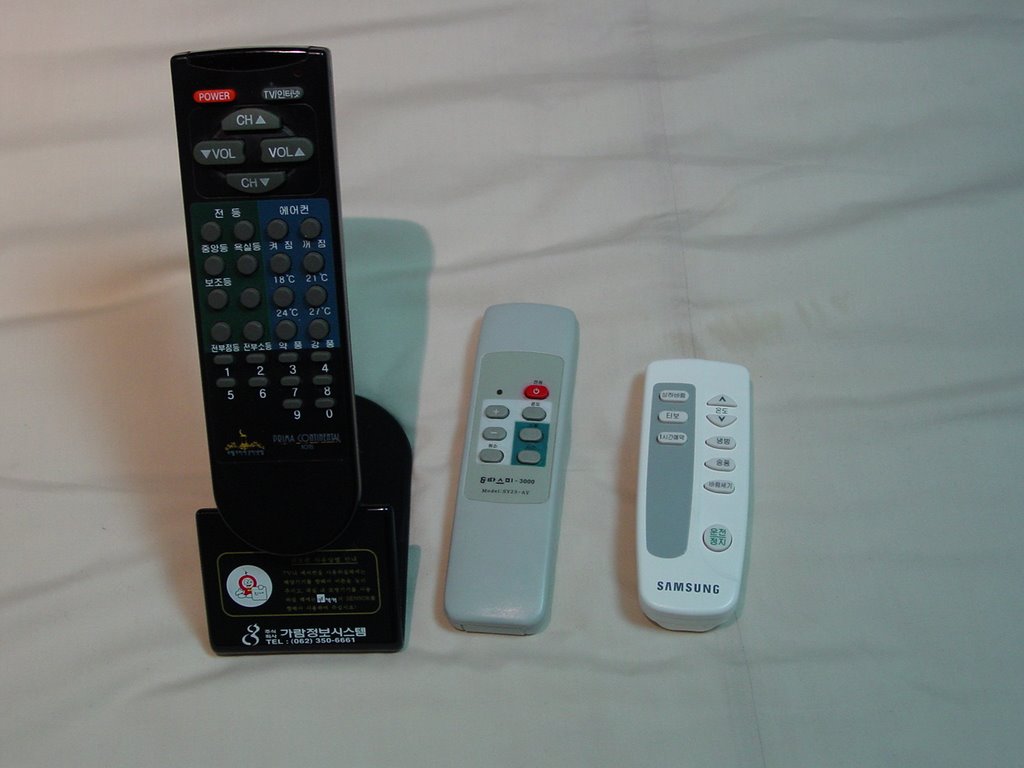
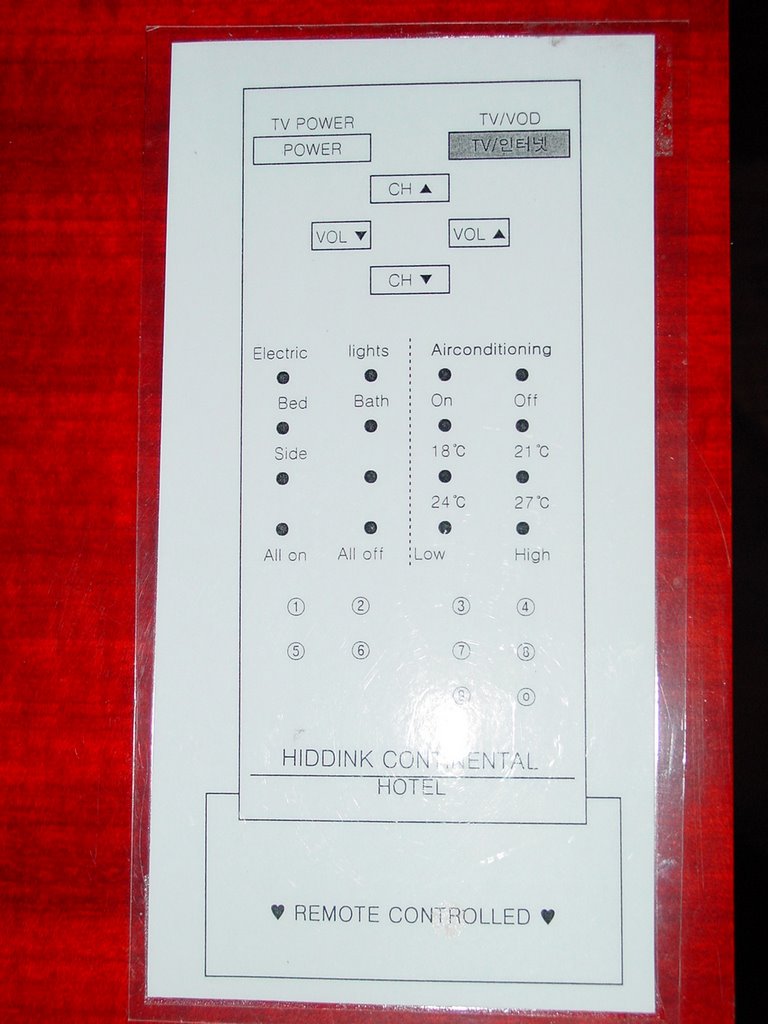
I’m supposed to call Shin Dong Kim when I get it, but I can never figure out the phones. So I get the front desk to call him for me; he and others are at a restaurant a ways away. Since it’s quite late and I have to speak in the morning, I excuse myself from joining them, set a time to meet him for breakfast, and head up to the suite to flip through the channels and fall asleep. There is a channel devoted to the game “Go,” another which seems to be just watching someone playing a videogame, another which is dedicated to US reality TV shows, and many many others, including music videos, game shows, dramas, films.
Early the next morning I get ready and head up to the restaurant for breakfast. I thought I was to meet Shin at 7:15 but he doesn’t arrive. I chat with some other folks from the conference. By 7:50 they’re moving people to the bus to take them to the convention center, so I go along. The bus is delayed, though I don’t know why, and we arrive about 10 till 9:00 (my talk is at 9). I meet up with Shin, who says that there was a miscommunication and that he was going to take me to the convention center in a cab. Anyway, apparently the party at the restaurant had gone very late (2am or so) and so people are very slow arriving. We decide to delay my talk until we can get a decent crowd, and so get started at 9:20. I had an hour to talk, now it’s down to 40 minutes (since there’s a panel right at 10). I talk fast, editing on the fly as I try to hit the high points, and most likely frustrated the hell out of the simultaneous translators (my apologies to them, since I know that is hard work in the best of circumstances). It’s quite a pan-Asian crowd. I answered some questions, and then was done. Chatted with folks a bit more in the hall outside, especially a very eager Korean graduate student. And then talked with Shin about mobile visual technologies (he borrows a grad student’s cell phone and shows me how it can play live television). Later I get a chance to look through all the conference materials, purchase the proceedings (several volumes), and then meet up with Keehyeung Lee, who I went to grad school with. Keehyeung, Shin, and I and others get lunch in a great local restaurant housed in the convention center. Apparently Gwangju is known for its food, which was wonderful. There is a local specialty which is a very strong smelling fish, and apparently few outside that region of the country like it. I ate a piece, which took a lot of chewing, and wasn’t, uh, problematic until I was almost done, when it became pretty overpowering. But I finished it nonetheless.
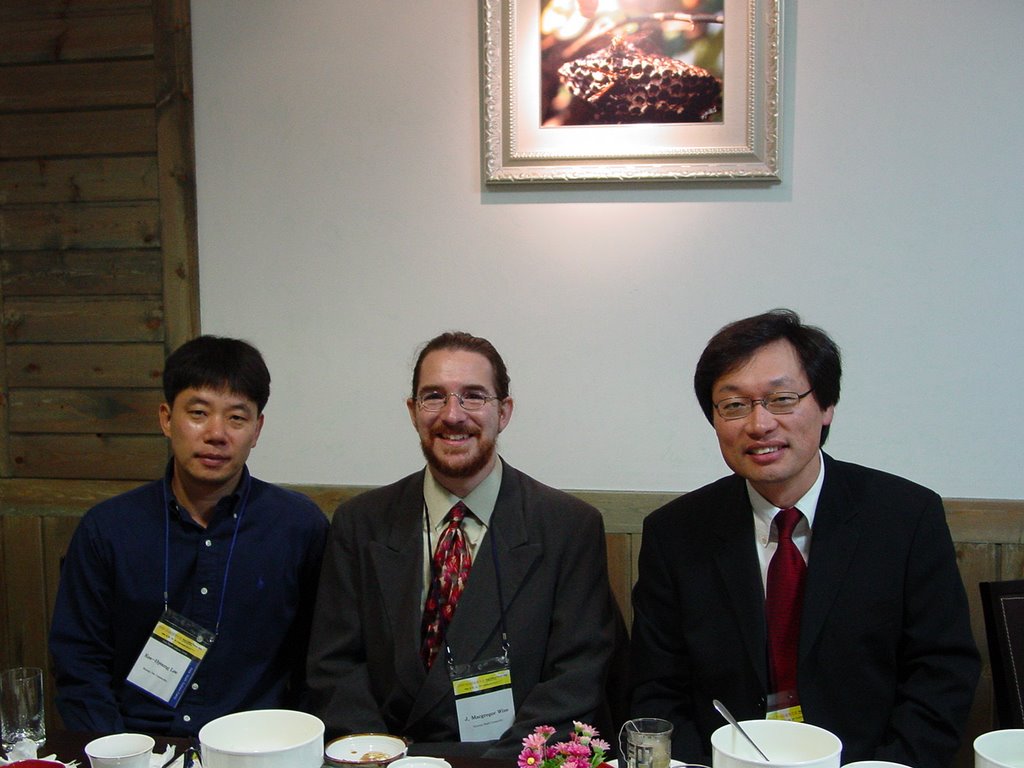
Keehyeung Lee, Me, Shin Dong Kim
That afternoon I went to a couple of panels, drank coffee (since the trip was beginning to hit me), did an interview for a local news website, and then caught a bus to the city center where they had a Youth Culture night with live entertainment and really great food. Run into Kuan-Hsing Chen briefly. Talk with folks doing mobile media research. Then walk back to the hotel where Shin commandeers the dining room for beer and karaoke for conference folk. Late (and no, I didn’t sing), I call it a night and head back to my suite.
The next morning (feeling not a bit of the allergies I arrived with), Sunday, reversed the process. Breakfast in the hotel (a buffet: rice, seaweed, corn, eggs, bacon, sausage, toast, seaweed soup, kimchee, green salad, cold cereal, muffins, orange juice, coffee, tea). Then a cab to the airport, plane to Gimpo, bus to Incheon, do some last minute shopping in the airport (picked up T-shirts for the kids, a couple of tea cups for Elise, and two CDs for me: the latest Crying Nut and Rollercoaster), and then it’s a 10-hour flight back. I slept most of the way, and still managed to read Steven Johnson’s Everything Bad is Good for You and watch Keanu Reeves and Sandra Bullock in The Lake House. A Scanner Darkly was also on, but the audio quality of those headsets was such that I promised myself to rent it later since I’d miss too much of the film. The flight back corresponded with Saturday night, and so I woke up and landed early in the morning on Sunday (again) in San Francisco. Then a flight back to Phoenix. And no discernible jet lag.
Of course, then Monday evening I had to give a talk on surveillance to a community group, so little time to rest.
All in all, a quite rewarding trip. It was great to be invited and given the opportunity to present a paper. My thanks, again, to Shin Dong Kim for inviting me. Great to meet new folks, see some old friends. My paper is online at their website.
Saturday, October 21, 2006
Korea
So, last Thursday I get an email from Shin Dong Kim, a scholar in Korea who studies mobile technologies and with whom I've been corresponding, saying that he was helping run a big conference and had just lost a keynote speaker. Since the plenary topic was culture and technology, would I be interested in speaking?
Next week.
In Korea.
So I'm currently in a mad scramble. But next Thursday I wing my way to Gwangju, Korea, to give a talk called "Technological Culture" to the Asia Cultural Forum. I arrive Friday evening, speak Saturday morning, and fly back Sunday. Won't get to see much of Korea this trip (I was there for ICA and a cultural studies preconference in 2002 and lived in Seoul for 2 years growing up, back in the mid-70s), and I wish I could stay for more of the Forum, which looks fascinating. Saturday seems dedicated to panels on Asian youth culture.
Next week.
In Korea.
So I'm currently in a mad scramble. But next Thursday I wing my way to Gwangju, Korea, to give a talk called "Technological Culture" to the Asia Cultural Forum. I arrive Friday evening, speak Saturday morning, and fly back Sunday. Won't get to see much of Korea this trip (I was there for ICA and a cultural studies preconference in 2002 and lived in Seoul for 2 years growing up, back in the mid-70s), and I wish I could stay for more of the Forum, which looks fascinating. Saturday seems dedicated to panels on Asian youth culture.
Wednesday, October 11, 2006
Gabbie, RIP
Well, we finally lost our Bichon Frise, the 16-year old irrepressible Gabrielle Button Woodstock ("Gabbie" or "Gabs"). She's been in declining health these last six months or so, sleeping more and losing weight. She finally went into kidney failure last week and died today (10/11/06). She will be sorely missed.
Gabbie has been part of our family since we lived in Illinois. She was the dog of a vet Elise's parents knew in Texas. The vet died, his widow couldn't care for Gabby, so Elise's mom babysat Gabs a lot. We brought her up to Illinois to find someone to adopt her (we knew someone who did pet adoptions) but she ended up taking over our house and never left. She's lived also in South Carolina, Georgia, and Arizona.
Bichons have a wonderful character. Often mistaken for frou-frou Fifi type dogs (especially since they can be groomed to be all fluffy snowballs) they are also scrappy little dogs with street smarts. Historically they're from the Canary Islands, used to be traded by Spanish sailors apparently. They ended up as court dogs for royalty (appearing in royal portraits) and later lost favor, becoming European street dogs before the breed was brought back. Which kinda sums up a bichon's personality: part royal lap dog, part streetwise, part "hello sailor," and very intelligent.
Gabbie has been part of our family since we lived in Illinois. She was the dog of a vet Elise's parents knew in Texas. The vet died, his widow couldn't care for Gabby, so Elise's mom babysat Gabs a lot. We brought her up to Illinois to find someone to adopt her (we knew someone who did pet adoptions) but she ended up taking over our house and never left. She's lived also in South Carolina, Georgia, and Arizona.
Bichons have a wonderful character. Often mistaken for frou-frou Fifi type dogs (especially since they can be groomed to be all fluffy snowballs) they are also scrappy little dogs with street smarts. Historically they're from the Canary Islands, used to be traded by Spanish sailors apparently. They ended up as court dogs for royalty (appearing in royal portraits) and later lost favor, becoming European street dogs before the breed was brought back. Which kinda sums up a bichon's personality: part royal lap dog, part streetwise, part "hello sailor," and very intelligent.
Tuesday, October 10, 2006
Book Award
"Culture and Technology" just won the Book Award for the Critical and Cultural Studies Division of the National Communication Association!
Woo hoo!
:)
Woo hoo!
:)
Subscribe to:
Posts (Atom)


