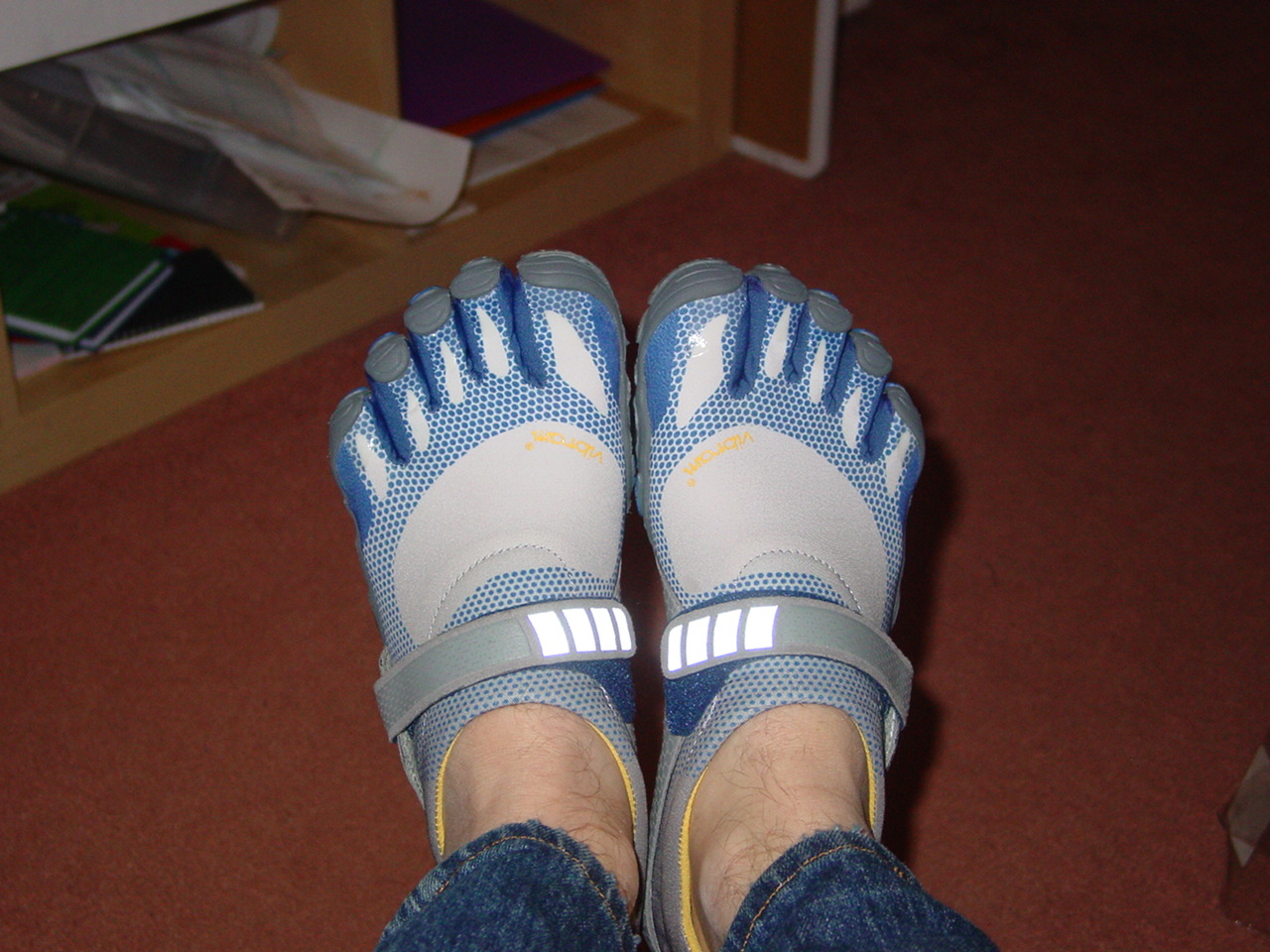
Thought I would try these out: Vibram "five fingers" barefoot running shoes. They are going to take some getting used to. I'll have to change how I run, for one thing (can't land on my heel and roll like in regular shoes: no padding; I'll have to land more midfoot). They are fun, though, and I've only worn them for a short jaunt or two until I get more used to them. And the last few days it's been too cold to be running "barefoot." It takes some practice to get them on (getting each toe in the right slot), but I'm getting the hang of that.
Friday, February 04, 2011
New Running Shoes
Thought I would try these out: Vibram "five fingers" barefoot running shoes. They are going to take some getting used to. I'll have to change how I run, for one thing (can't land on my heel and roll like in regular shoes: no padding; I'll have to land more midfoot). They are fun, though, and I've only worn them for a short jaunt or two until I get more used to them. And the last few days it's been too cold to be running "barefoot." It takes some practice to get them on (getting each toe in the right slot), but I'm getting the hang of that.
Sunday, January 30, 2011
New books
New books (in no particular order):
Kuan-Hsing Chen, Asia as Method (Duke, 2010). Which looks fabulous. Thinking of setting this as a text in next Fall's grad class: Globalization and Advocacy.
Donna Haraway, The Companion Species Manifesto (Prickly Paradigm, 2003).
Hardt & Negri, Commonwealth (Harvard, 2009). Playing with the idea of teaching this next Fall, too. But need to engage it more first.
Jussi Parikka, Insect Media (Minnesota, 2010). Thanks to Greg S. for the heads up on this one. Looks great, and quite useful as the Primer revisions continue.
Ben Highmore, A Passion for Cultural Studies (Palgrave, 2009) and The Design Culture Reader (2009, Routledge). [Thanks, Ben!]
Lawrence Grossberg, Cultural Studies in the Future Tense (Duke, 2010), which is brilliant.
and then there's the Affect Theory Reader (Duke, 2010) by a couple of people named Greg(g). :)
Kuan-Hsing Chen, Asia as Method (Duke, 2010). Which looks fabulous. Thinking of setting this as a text in next Fall's grad class: Globalization and Advocacy.
Donna Haraway, The Companion Species Manifesto (Prickly Paradigm, 2003).
Hardt & Negri, Commonwealth (Harvard, 2009). Playing with the idea of teaching this next Fall, too. But need to engage it more first.
Jussi Parikka, Insect Media (Minnesota, 2010). Thanks to Greg S. for the heads up on this one. Looks great, and quite useful as the Primer revisions continue.
Ben Highmore, A Passion for Cultural Studies (Palgrave, 2009) and The Design Culture Reader (2009, Routledge). [Thanks, Ben!]
Lawrence Grossberg, Cultural Studies in the Future Tense (Duke, 2010), which is brilliant.
and then there's the Affect Theory Reader (Duke, 2010) by a couple of people named Greg(g). :)
Monday, January 17, 2011
New Materialisms
This is one of those things that is probably unsurprising to others, but was something of an "aha" moment for me. And that is this:I tend to see my research and writing interests as somewhat eclectic. There are definite themes (technology on the one hand, globalization and culture on the other), but little in the way of overarching unity. Anyway, I've been included in two collective projects on materiality, one by Jeremy Packer and Steve Wiley out of North Carolina on materiality and communication, where I'm talking about assemblages of attention, and another on materialities of new mobile media, through Andrew Herman, Thom Swiss, and Jan Hadlaw, based on a workshop that will take place next week in Waterloo, Ontario. So I've been reading up on the new materialist turn. Looking through the introduction to Diana Coole and Samatha Frost's new collection, New Materialisms (2010, Duke), I was struck with how wide an umbrella they're setting up for the materialist turn, bringing in interest in sociologies of the everyday (Lefebvre, de Certeau), the phenomenology of the ordinary, critical geographies of space, etc. (p. 28). And I started realizing that this new materialism could be the connecting thread that runs through all my projects, a common perspective on all this stuff. Deleuze (naturally), studies of technology (from a decidedly materialist/Deleuzian perspective), studies of everyday life, the critical geography work I draw on for my book on cultural globalization, current interests in embodied cognition. Especially when I could articulate the cultural globalization book to the culture and technology one (since the former has little on technology), I found that of interest.
Unsecured surveillance cameras
Surveillance cameras connected through unencrypted/non-password-protected links are readily accessible online, it seems.
http://arstechnica.com/gadgets/guides/2011/01/one-mans-journey-through-the-world-of-unsecured-ip-surveillance-cams.ars
Reminds me, yet again, about Baudrillard on the obscene: the whole world unfolds unnecessarily on your home screen. [quote from memory, so perhaps inaccurate]
http://arstechnica.com/gadgets/guides/2011/01/one-mans-journey-through-the-world-of-unsecured-ip-surveillance-cams.ars
Reminds me, yet again, about Baudrillard on the obscene: the whole world unfolds unnecessarily on your home screen. [quote from memory, so perhaps inaccurate]
Tuesday, December 21, 2010
Your apps are spying on you
Is anyone surprised by this story in the Wall Street Journal, "Your Apps Are Watching You" (18 December, 2010). It begins: "Few devices know more personal details about people than the smartphones in their pockets: phone numbers, current location, often the owner's real name—even a unique ID number that can never be changed or turned off..."
I was dismayed to see Paper Toss as one of the offenders they looked into :(
Sunday, December 19, 2010
LPFM!
Congress actually passed the long-delayed Community Radio Act, allowing low power FM radio stations (usually these reach just a mile or more, are relatively cheap to set up, and create opportunities for more groups to reach the airwaves). This has been blocked by the big radio networks for a long time.
http://www.huffingtonpost.com/timothy-karr/the-little-bill-that-coul_b_798768.html
Wednesday, November 17, 2010
Dragonfly

Was walking out to my car the other day and suddenly wondered why I had never noticed the interesting filligree doohickey (those are technical terms, y'all) that was part of our car's antenna. It looked cool. I got closer and saw that it wasn't part of the antennae, but a dragonfly. It very patiently stayed there while I snapped a couple of images with my phone, and then zipped off.
New Books
Just back from NCA. Picked up the following, which look great:
Jonathan Gray, Show Sold Separately: Promos, Spoilers, and Other Media Paratexts. NYU Press.
Thomas Streeter, The Net Effect: Romanticism, Capitalism, and the Internet. NYU Press.
Got in the mail the other day:
Ben Highmore, Ordinary Lives: Studies in the Everyday. Routledge. I had read this in manuscript form and loved it. Glad it's finally out.
Jonathan Gray, Show Sold Separately: Promos, Spoilers, and Other Media Paratexts. NYU Press.
Thomas Streeter, The Net Effect: Romanticism, Capitalism, and the Internet. NYU Press.
Got in the mail the other day:
Ben Highmore, Ordinary Lives: Studies in the Everyday. Routledge. I had read this in manuscript form and loved it. Glad it's finally out.
Thursday, September 09, 2010
updating Orwell
Under the spreading chestnut tree,
I friended you,
and you friended me...
[updating Orwell's parody of a popular song/rhyme, which itself is echoing Longfellow]
I friended you,
and you friended me...
[updating Orwell's parody of a popular song/rhyme, which itself is echoing Longfellow]
Tuesday, September 07, 2010
The Conversation (1974)
The infamous Jack Tarr hotel, where the key confrontation occurred in this great film, is slated for demolition (if it's not gone already). It was renamed the Cathedral Hill hotel a number of years ago. Apparently not too many people are sad to see it go (a dead end of modernist architecture, someone wrote, actually they said, "the bad direction modernism went"). It's going to be replaced by a new hospital complex.
new books
New books, accumulated over the last few months. Some purchased, and some just appeared in the mail (thank you!!) In no particular order.
Goggin & Hjorth, Mobile Technologies: From Telecommunications to Media. Routledge
Paul Virilio, The University of Disaster. Polity.
Campanella Bracken and Skalski (eds) Immersed in Media: Telepresence in Everyday Life. Routledge.
Solove, Understanding Privacy. Harvard.
Vivian, Public Forgetting. Penn State.
Papacharissi (ed), A Networked Self: Identity, Community, and Culture in Social Network Sites. Routledge.
Turner, Ordinary People in the Media.
Crow, Longford, & Sawchuk (eds), The Wireless Spectrum. University of Toronto Press.
Currently reading: Qui Xiaolong, Death of a Red Heroine, a mystery recommended by Jennifer (thanks!). Though I am also inching my way through both Against the Day (which is taking years, I realize, which is not necessarily the book's fault) and Vineland by Pynchon. Finished Inherent Vice, which was fun.
Goggin & Hjorth, Mobile Technologies: From Telecommunications to Media. Routledge
Paul Virilio, The University of Disaster. Polity.
Campanella Bracken and Skalski (eds) Immersed in Media: Telepresence in Everyday Life. Routledge.
Solove, Understanding Privacy. Harvard.
Vivian, Public Forgetting. Penn State.
Papacharissi (ed), A Networked Self: Identity, Community, and Culture in Social Network Sites. Routledge.
Turner, Ordinary People in the Media.
Crow, Longford, & Sawchuk (eds), The Wireless Spectrum. University of Toronto Press.
Currently reading: Qui Xiaolong, Death of a Red Heroine, a mystery recommended by Jennifer (thanks!). Though I am also inching my way through both Against the Day (which is taking years, I realize, which is not necessarily the book's fault) and Vineland by Pynchon. Finished Inherent Vice, which was fun.
Sunday, August 29, 2010
The everyday
Currently teaching a course on media and everyday life. Right now we’re early on in the course and covering basic ideas about the everyday. Students seem to be enjoying it. But reading and teaching about such things always gets me reflecting on everyday practices, naturally enough.
We read Mauss’s “Techniques of the Body” which got me reflecting on when and where people walk around clasping their hands behind their backs (it’s either very formal, like in school or a form of attention, or quite informal—a stroll, though the latter seems to be a generational thing; do people do this anymore?).
The other somewhat random thought came up when the A/C system kicked on a bit earlier today. The thermostat is programmed by time of day and day of the week, so you can set it to your habits, or the habits of the household. When we first moved into this house years ago, it was set to someone else’s everyday. There was the preferred temperature (and preferred nighttime temp, daytime temp, etc.). But also the timer gives a clue to the schedule of the house: when it first kicks on (people are waking up), kicks back off (people have gone to school or work; or perhaps it doesn’t kick back off if they stay at home), back on in the afternoon (when expected home from school or work), and back off in the evening (when we go to bed); with different patterns for the weekend (does it shut off Sunday morning when you’re not expected to be at home?). Until I figured out how to change the programming, we were living in a house set for another family, continually overriding their everyday. It’s about the ways the everyday accretes in technologies and spaces.
We read Mauss’s “Techniques of the Body” which got me reflecting on when and where people walk around clasping their hands behind their backs (it’s either very formal, like in school or a form of attention, or quite informal—a stroll, though the latter seems to be a generational thing; do people do this anymore?).
The other somewhat random thought came up when the A/C system kicked on a bit earlier today. The thermostat is programmed by time of day and day of the week, so you can set it to your habits, or the habits of the household. When we first moved into this house years ago, it was set to someone else’s everyday. There was the preferred temperature (and preferred nighttime temp, daytime temp, etc.). But also the timer gives a clue to the schedule of the house: when it first kicks on (people are waking up), kicks back off (people have gone to school or work; or perhaps it doesn’t kick back off if they stay at home), back on in the afternoon (when expected home from school or work), and back off in the evening (when we go to bed); with different patterns for the weekend (does it shut off Sunday morning when you’re not expected to be at home?). Until I figured out how to change the programming, we were living in a house set for another family, continually overriding their everyday. It’s about the ways the everyday accretes in technologies and spaces.
Wednesday, August 25, 2010
in the news (old)
A former student of mine just sent me a copy of an article from last January from a college newspaper, The College Times. I remember talking with the reporter, but never saw the issue. So this is 8 months old, and I'm cited several times later on.
FWIW.
FWIW.
Friday, July 02, 2010
Beyond the Lighted Stage
Quite enjoying this documentary of Rush. Lots of old footage and interviews. Doesn't presume you're a fan. Deals with the seemingly utter lack of respect the band gets from rock critics (and reads out choice excerpts of scathing reviews). But as a portrait of a group of friends who have managed to hang together as a band for 40 years (accumulating the most consecutive gold or platinum albums except for the Beatles or the Rolling Stones), it's quite good. There's no scandal here, and none of the usual heavy metal excesses. Geddy, at the end, says that he told the filmmakers they were making a mistake: the band was just too boring. They're not boring, however, but are funny, reflective, honest guys (who happed to be extremely talented musicians). The documentary quietly skips a few late 80s albums (e.g., Presto), which is probably for the best :)
Friday, June 25, 2010
New Old Media
Wednesday, April 28, 2010
Surveillance Birdhouse
I love this!
http://sleekidentity.com/products/detail/wolfgang-s-birdhouse-Dennis-Clasen/
Saturday, December 26, 2009
Up in the Air
Interesting reflection on non-places and hyperreality. In some ways, we could read George Clooney’s character’s (Ryan Bingham) life as the condition of postmodernity: living in the in-between, in non-spaces which are all shiny surface, desire collecting around rewards points and mileage levels, ephemeral signs of status. In this way, given the films critique of Bingham’s life, could this be a parable of the end of the postmodern?
There is a parallel of the airworld nonspace with another one: cyberspace. The plot revolves around a scheme to fire people online rather than face to face (and someone breaks up with their fiancée via text message). It seems the same shallow, friction-free space as the postmodern world of airports and chain hotels. The next generation, embodied in the up and coming Natalie Keener (played by Anna Kendrick), seems heading towards the same disconnect as Bingham.
The film offers no simple solutions (for which I was grateful), though it being a Hollywood film it makes some predictable conclusions (triumph of humanity over technology—that shouldn’t be a spoiler, by the way), though it does leave things, for some, up in the air.
[new post coming up on the Clickable World blog, too]
There is a parallel of the airworld nonspace with another one: cyberspace. The plot revolves around a scheme to fire people online rather than face to face (and someone breaks up with their fiancée via text message). It seems the same shallow, friction-free space as the postmodern world of airports and chain hotels. The next generation, embodied in the up and coming Natalie Keener (played by Anna Kendrick), seems heading towards the same disconnect as Bingham.
The film offers no simple solutions (for which I was grateful), though it being a Hollywood film it makes some predictable conclusions (triumph of humanity over technology—that shouldn’t be a spoiler, by the way), though it does leave things, for some, up in the air.
[new post coming up on the Clickable World blog, too]
Sunday, November 29, 2009
Rainbows
Subscribe to:
Posts (Atom)
