Tuesday, February 17, 2009

The Senators


So, I got an invitation out of the blue to attend a breakfast with Jon Kyl, Senator from Arizona and current Republican Whip, which was taking place on our campus. There ended up being about 70 people or so attending, at 7:30 this morning, mainly business and community leaders with a handful of faculty. I was certainly the only guy there not wearing a tie and jacket. Kyl spoke for a while, primarily about how terrible he felt the “so-called stimulus bill” (his words) was. At one point the head of the Maricopa Community College District (the largest in the country) asked a question about their financial crisis and if the stimulus plan could help and Kyl said back, in no uncertain terms, that first off he felt that education was a local issue and it was a mistake for the federal government to get involved in education (funding, I would presume). Anyway, for the life of me I couldn’t think of a question I wanted to ask, or at least one with any chance of getting a real response.

And then in walks Senator McCain (there's a hyperlink there, but who doesn't know who he is at this point?), which was something of a surprise (a brief moment thinking, “that’s not…”). He looks much like he does on TV, a touch less hair. Everyone immediately leaps to their feet and starts clapping. He and Kyl answered a few more questions, primarily criticizing the stimulus bill, though McCain took some time to put in a pitch for a guest worker program and argued that we need to be much more worried than we seem to be about drug cartel violence in Mexico. I notice a couple of folks getting out cell phones to snap pictures. Then they both swept past me and out.

I found out they had a press conference scheduled in the next room, and since I was ASU faculty they let me hang out in the back of the room (and, yes, snapped a blurry cell phone picture). I was mainly curious to watch how the whole press conference thing worked, what the reporters would ask, how they would answer, and so on. It was a pretty sparsely attended conference (see above picture). I bet the Senators were wondering who on earth that long-hair was hanging around the breakfast and conference. Anyway, news reports of the press conference here and here and here. The Senators certainly have their talking points down about the stimulus package (“neither bipartisan nor stimulus”; “generational theft”; etc) and the economic crisis (according to them they’ve been pleading with the congress to do something about this pending housing crisis since the early 2000’s, but those darn Democrats would have none of it). The reporters were definitely asking more pointed questions than the community leaders, not surprisingly.

The vast majority of the political news in Phoenix today is about Obama’s visit (he’s in town overnight to introduce his housing plan in the morning), coverage of the Kyl-McCain press conference seems limited to smaller papers (or Fox news--the Grand Canyon metaphor and graphic on the flatscreen display towards the start of this piece is hysterically bad). Anyway, glad Obama’s in town, jealous of a friend of ours who got a ticket to see him, and hoping that traffic’s not too tied up because of the visit that I can’t get the kids to school.

Saturday, February 14, 2009

Electric Cars

So, ever since I saw “Who Killed the Electric Car,” I’ve been somewhat interested in this vehicle, though haven’t studied it in any depth by any means. But I find it irritating that the Chevy Volt is being touted as a new innovation, when not only have electric vehicles been around for almost as long as internal combustion engines but that there were a number of models out and about in the 1990s (which were withdrawn and scrapped without a real explanation as soon as California lifted its regulations requiring a certain number of 0-emission vehicles on the road). Anyway, that’s the thesis of the documentary.

In today’s paper there’s an article on the Volt. Costing between $30K and $40K it can go up to 40 miles on a charge. After that a small internal combustion engine kicks in. So, for local trips only.

Later in the paper, there’s a review of the Tesla Roadster, an all-electric sports car. Now, I’m not a car guy by any means, but wow! Interestingly, this high performance vehicle can go about 200 miles on a charge (if going fast; if going slower—as if!—it can get up to 240 miles). Also for fairly local trips. This is for the very exclusive price of $109K, so I won’t be making that down payment any time soon.

But, running the numbers, if you divide car price by mileage, here’s what you get: the Volt, taking the midrange price: $35,000/40=$875/mile. The Tesla, taking the lower mileage: $109,000/200=$545/mile!

I’m not sure what to conclude from this, except I doubt that the Volt will be as impressive as it probably could be, and doubt that Chevrolet’s heart is really in it. Though I would have said that before I read these articles anyway.

ASU

No news. Just additional concern about changes at the west campus (e.g., here and here).

Apparently there's some meeting next week with representatives from State Government, ASU, and the city of Glendale regarding the West Campus. No details offered. Not sure if this is a renewal of the proposal to somehow spin the west campus off to become it's own State College, though that's apparently a plan on the table (as is the plan to shut the west campus down, and a plan just to continue as New College).

Friday, February 13, 2009

More ASU

No new info, just reactions.
Here
and
Here

Tuesday, February 10, 2009

ASU

Well, I haven't had much in here about ASU's financial difficulties which are the result of the State of Arizona's cutbacks. I'll just post a link to the latest:

http://www.azcentral.com/community/tempe/articles/2009/02/10/20090210asuadjustsonline.html

http://www.azcentral.com/community/glendale/articles/2009/02/10/20090210gl-asuwest0210-ON.html

Key for us is the loss of our Master's Program (and all MA programs on our campus).

We'll see what this all means...

Sunday, February 08, 2009

A grumpy dispatch from the clickable world


What could this be? The answer my friends: a photo of the inside of my pocket. Yes, a photo of the inside of my pocket. Why do I have such a photo? Well, let me tell you.

My cell phone finally died last month. It was a rugged little thing, made by LG, that was battered and scratched, but had lasted for years. It was simple, without bells, whistles, or a camera. But finally, one day, it went through the wash, and that was just too much for it. Now, it tried to hang on for a few days after The Incident, sputtering to life, screen flickering meekly, seeking a signal from out of the aether, but finally flatlining (and taking down all my contacts and phone numbers with it).

As a replacement, I sought out something also non-flashy, simple; in other words, a phone and not an electronic Swiss Army knife. But cameras are ubiquitous these days and I ended up with a Samsung phone with a camera. It was about a week into my time with this new device when I discovered the Design Flaw. There is a button on the side which, when tapped lightly, turns on the display. I should note as an aside that as a power-saving feature the external screen goes black after a few seconds. My old phone kept the display going, so I could use it as a clock during lectures. This phone I can't. Anyway, if you press and hold down the side button it turns on the camera.

You're way ahead of me.

Every so often, as I go about my daily business, I hear the digital reproduction of a shutter clicking from somewhere in my pants pocket. The button has been pressed by keys or a nail clipper or loose change (or my hand seeking any of these items) and the camera has been activated. It happily starts taking pictures. In the month I have had this phone I have had to delete, I kid you not, over 150 of these pictures. Most are pitch black. I think the above photo, and a couple of its companions, are from a day I was wearing khakis and light seeped through the fabric.

In any case, if we are to make any progress towards wearable computers, someone needs to solve this button problem. An electronic device with a button subject to jostling, gets jostled in a pocket, purse, or bag. This was a problem with my old Palm Zire. The power button was too exposed and it would turn on in my bag and the power would drain away (and when the power was gone, so was the memory, and anything not backed up: poof). This was also a problem with the first set of remote car keys I ever got (being suspicious of them on principle for years: key--lock seems safe; key fob--radio signal--carlock seems less safe, but that's just me). I would accidentally unlock the van or open the sliding doors while I was inside my house. I'd go out and it would be open. Or I'd set off the alarm. I'm glad I don't have one of those remotes which remote starts the car or else my vehicle would head off like the Batmobile. Luckily it seems to have calmed down and for some reason isn't as sensitive anymore, or perhaps I've just trained myself to keep my keys free and out until I'm out of range. That's probably it. "Change for the machines," as Pat Cadigan once wrote in Synners.

Friday, February 06, 2009

Bill Posters Will Be Band

A couple of links to live performances of the Bill Posters Will be Band, an anarchic British jazz group made up of performers from a variety of other groups including the Bonzo Dog Doo Dah Band.

http://www.vimeo.com/album/42487

http://www.youtube.com/watch?v=Ius1f9b1Ybw

Their home page: http://www.billposterswillbeband.co.uk/

Elise and I know (or, at least, knew, since it's been ages and ages since we've seen him) one of the members of the troupe, Jim "Golden Boots" Chambers, through a friend of a friend. We were given Jim and Sharon's contact information when Elise and I were over in England as undergraduates for study abroad back in the mid 1980s. Jim and Sharon were always very kind and welcoming and we loved visiting them in their house south of London. Jim worked as a curator at the Natural History Museum in London, in charge of the fish section. I went with him to work one day and he showed me some of the preserved specimens in a back storeroom, some well over a hundred years old (and some apparently collected by Darwin himself, though I don't recall). Bill Posters was his occasional gig. He's the sax player with the long beard and the John Lennon glasses.

Thursday, January 01, 2009

Bad Ideas

A collection of random Bad Ideas (by me, not collected from elsewhere):

1) Reality TV Show: "So You Think You can Dance Like an American Fifth Grader" [OK, that's more parody than a bad idea...]

2) Cell Phones with customizable scents. Just like you can customize your phone to ring a different tune for different callers, embed one with technology to make different scents. So rather than an annoying ringtone, you get a slight waft of something, telling you that you have a new text message, or call. Different scents for different folks (flowery, acrid, and so on). Scent, unfortunately, is not as quick as sound so that's a negative factor here (missed calls if you're in so much as a slight breeze). And it's also as public as sound ("Is that you or did your boss just call?")

3) One upon a time I actually drafted a parodic post in response to a news article on NASA's budget troubles, though I don't think I ever posted it. Might lead Bad Ideas II with that one later on, but given proximity of this post with the previous one I'll hold off for now (though it may have come through on an earlier posting).

Tuesday, December 30, 2008

Columbia report

http://www.nasa.gov.pdf/298870main_SP-2008-565.pdf

This is gripping, horrifying, and tragic. It's the final report on the spaceshuttle Columbia's catastrophic re-entry in 2003, complete with acronyms (CMCE: Crew Module Catastrophic Event). In some ways its coldness and technicality is a way of respecting the privacy of the deceased [a number of redacted sections at the end also keep personal details private]. But its second by second account has an inexorable fatalism, watching a disaster unfold in slow motion (watching technology fail) knowing there's nothing you can do. In the end the crew didn't suffer. But man, reading this really hits me hard.

Monday, December 08, 2008

Speeding Cameras

Arizona is rolling out quite a number of new automated speed and red light cameras, an expansion which is expected to continue. See the article here.

Cutting down on speeding around here is a good thing (130mph??). But what's always worrying about such technologies is their function creep. Also, they're a technical fix that doesn't consider why people are driving so much and have to go so far (urban planning) and have to get there so quickly. Broader, and deeper, social questions.

Of course, do the cameras work?
Here's the Independent from London this summer.

Monday, December 01, 2008

What Color is Your House?

An interesting post about airport security and the new surveillance by Anita Allen over at the blog Daily Beast. How to get through security if you lack proper ID and the sorts of things they can find out about you.

Wednesday, November 26, 2008

The Case Against Electronic Books (take 2)

Miscellany

1. After around two and a half years of blogging, Ain't Got Time to Blog just logged it's 2,000th visit ("Low Traffic Site" I think is the phrase). Our final push over the top is due to the popularity of MC Howie and Julie and those searching for them on the web ending up here. Add to that some searches for Crying Nut and a few for Faye Wong. And even a few folks looking for me, this blog, or something I wrote.

2. Starting an occasional anecdotal series in this blog: "Argument Against Electronic Book Readers"
Our first entry I scrawled on the back page of Galloway and Thacker's "The Exploit" towards the end of Monday's flight from San Diego to Phoenix. "As we make our final descent into Phoenix, please turn off all portable electronic devices until we are on the ground."

3. As a side note regarding Monday's flight: Southwest is stating in ads that they now serve Monster beverages on board. Just what I need when packed like a smoked oyster (hah--thought I'd say "sardine"?) into a flying tin can: some guy hyped up on power drinks twitching in the seat next to me. What could be worse? Well, the day they allow cell phone calls on flights, that would be worse.

4. Update on the College of Human Services (CHS) saga: as of last Friday (21 November) the college and department are officially disestablished. In terms of the upcoming convocation, we (Com Studies faculty and students) are now back with the resurrected-for-one-day-like-David's-Mom-in-A.I. CHS for one final Convocation ceremony with our students before we join our new colleagues and students in the New College in next Spring's Convocation.

Sunday, November 02, 2008

Limbo

[despite the date above, this was posted 11/8/08]

So, while we wait for the official vote by the Arizona Board of Regents in December or late November to dissolve the Department of Communication Studies and the College of Human Services, they are for all practical purposes gone. The Dean has been un-Deaned (and is currently an Interim Vice Provost) though I’ve heard rumors of an Acting Dean (somewhere), our Chair has been un-Chaired, all of the Dean’s staff is gone, Com Studies faculty now officially report to the Division of Social and Behavioral Sciences in the New College of Interdisciplinary Arts and Sciences, our students are now being advised by an Advisor on the other side of the building (rather than around the corner from our offices), and so on.

The latest oddity in this whole process is that the College of Human Services will be resurrected for one last Convocation Ceremony in mid-December. However, as I understand it, the ceremony will be run by administrators from a different college (where the other departments and schools from CHS have gone), and Communication Studies will not be taking part. We (faculty and students) will be at the New College’s ceremony. I wonder what our students will make of the switch?

By the way, none of this is a reflection on my new colleagues or administrators in the New College. It’s just an observation on the strange limbo-like state that has been this semester.

This is also in the midst of another round of budget cuts. See the story in the Arizona Republic (and note the plan to have classes with up to 1,000 students in mass lectures). And the New York Times just picked up on some of the adjunct faculty layoffs--things are bad all over.

Supermarket surveillance

So you know that supermarket rewards cards help create nice consumer profiles of you. A concrete example of this just arrived in the mail from the grovery store we tend to frequent. It included 16 "personalized coupons" for things we "buy the most." They were (of course) pretty, scarily accurate (missed on a couple of things: we don't buy Coke Classic, for example, and do we really buy black olives that often? Maybe. And the offer of the free cashews is just trying to redirect our nut-buying habits onto new products). But they were also, sigh, really useful.

Of course, what the store can't profile are the things we buy at other places because they aren't available at their store (fair trade, organic coffee, for example), so the system just reinforces specific things from their own stock. It's a closed cybernetic system (teaching Andrejevic's iSpy next week, so this is all bouncing around in my cranium anyway).

Friday, October 24, 2008

MC Howie and Julie

I love these people.


Thursday, October 23, 2008

Culture + Technology

Culture + Technology: A Primer just went into its 4th printing. I'm glad that so many have found it a useful book. It's quite exciting.

Tuesday, October 21, 2008

Backscatter Backlash?

Well, that's overstating the case (but makes a good headline). European Union is debating whether to allow backscatter devices at airports. New York Times article here.

And just to add to the theme of airport surveillance: the lastest passenger screening protocol (e.g., terrorist watch lists) is being worked out. See the Arizona Republic (channeling an AP story) here.

Thursday, October 16, 2008

Post-Debate Photo


OK. I didn't watch the last debate. Even so, I don't understand this picture at all (apparently McCain caught himself going in the wrong direction). One of those unfortunate images. But I can't stop laughing.

Image is from Reuters, via the Huffington Post

Saturday, October 11, 2008

politics

Haven't had much on the election in here. But this one thing has been bugging me.

Newsweek (and others, but this excerpt is from Newsweek) describes a recent McCain rally:

At a town-hall event Friday in Minnesota, McCain took the microphone from a woman who said Obama is an Arab. McCain said, "No, ma'am," and he called Obama "a decent, family man."

I understand that McCain is trying to temper the comments of his supporters, but rather than simply denying that Obama is an Arab he makes the argument that he's a decent family man, as if that's the opposite of being Arab. Arabs certainly can be decent family men!

Jeez.

Friday, September 19, 2008

National Security and Kids (again)

Apparently Sesame Street has teamed with Homeland Security to teach kids about emergency preparedness. This is a follow-on from a previous post of mine (ain't got time to link) on national security and kids. Again, gotta be a paper in here somewhere.

Fira, take 2


Apparently they think she's a "mixed somali". Note how long her tail is.

More airport scanning

Breathe deeply, calm down, it's just a security check, nothing to worry about, forget that the cameras can tell if you're nervous, pulse racing, stressed. At least, that's the project: remote physiological scanning of passengers looking for signs of stress.

Monday, September 15, 2008

Fira


New cat in the family. First pet since Edmund passed away last year, and first cat in 14 years.

Fira is from the Humane Society. 2 yrs old female. Interesting mix of breeds. Medium-long hair, tortoise-shell coloring (looks like a thin Maine Coon), very thin, with a tail almost longer than she is. Quite friendly. More pictures later.

Book Signing

Signing copies of Cultural Globalization: A User's Guide at the Borders Books and Music at Camelback and 24th Street in Phoenix. This Friday, 19 September, from 6-8pm.

Note that the events page that the above link takes you to actually omits my signing (sigh), but that's par for the course.

Sunday, September 07, 2008

Langdon Winner

Just discovered that Langdon Winner has a blog:
http://technopolis.blogspot.com/

Thursday, August 21, 2008

Irony

One irony in all of this regarding the dissolution of the College of Human Services is that we all got brand new College of Human Services logo polo shirts just last week.

[I'm using "irony" here in the Alanis Morissette usage rather than the more literary usage.]

Monday, August 18, 2008

Bye-Bye College of Human Services

ASU's restructuring again. We (department of comm studies) are moving to the New College of Arts and Sciences. Arizona Republic's article here. ASU's official announcement here (which doesn't actually mention that the college is going away entirely, I don't think).

Monday, August 04, 2008

Distracted

Just picked up Maggie Jackson’s book, Distracted, which has been getting a lot of discussion this summer (on NPR at least). I've been saying for a while that we need to pay more attention to attention, so I'm glad to see the issues being debated. Might even spur me on to write more about it. Haven’t delved very far into the book [insert cheap Attention Deficit joke here] but did like the following nuanced passage, which nicely balances out the tech and social determinist positions on technology. The state of affairs she’s describing isn’t technology’s fault, but neither is technology blameless.


PowerPoint doesn’t make us dumb, and a judicious use of such slideware likely can help us navigate a world of information overload. I’m not angling for a return to some sort of pastoral, unmechanized Eden in order to halt the erosion of attention. We cannot blame technology for society’s ills. Nor can we fall into the opposite and increasingly commonplace trap of blindly trusting that our new tools will automatically usher us into a glorious new age. The tools we are wholeheartedly embracing today are inherently powerful, and we ignore that truth at our peril. You can use a stick for digging potatoes or stabbing your neighbor, so how you use a stick is important, but equally important is the fact that a stick is not a wheel. It’s crucial that we better understood how our new high-tech tools, from video games to PowerPoint, may be affecting us. Moreover, our tools reflect the values of our times, so it’s no coincidence that PowerPoint is a tool of choice in a world of snippets and sound bites.
p. 21
Maggie Jackson, Distracted: The Erosion of Attention and the Coming Dark Age. Amherst, NY: Prometheus Books, 2008.

Tuesday, July 29, 2008

Reading, part 2

Thinking more about all the recent debates about reading online (is Google Making us Stupid, and today’s NYT article on whether or not we’re reading online--and someday I may provide links) has me reflecting on my own reading practices. Like the author of the Atlantic piece, I too have a hard time sitting down and reading long books. But in my case one reason (or, perhaps, excuse) isn’t the ability to concentrate, but rather the distractions of young children. Being a very involved, hands-on parent means that I don’t have long stretches away from them to read. It’s easier to do quick things on the computer in the office when the opportunity arises because it’s usually interruptable and it makes us feel busy. We’ve worried that our children probably don’t see us modeling book reading that much as a consequence of this. On the other hand, our house is filled with probably thousands of books (less so nowadays in that a number are in storage since we’re trying to sell the house—apparently books count as clutter) and it’s said that just having books around is a good influence on children. As the kids get older (and learn to read and hopefully enjoy reading), we’re hoping to have more time to sit down for longer stretches and get back into some books.

As an aside, there’s a debate in the NYT piece about books not giving a variety of perspectives, or web-reading being broad but shallow. I wonder if web reading is in the end more solipsistic (that is, self-centered); yes you are the one putting together the beginning, middle, and end of the story, you are gathering the pieces you need and contributing as well to the ongoing conversation. This is the fully customizable Daily Me that Negroponte talked about a decade or more ago. But getting lost in a book, either fiction or non, means immersing oneself in someone else’s world**, which is an important skill (to stand in someone else’s shoes, getting away from oneself).


**Yes, I know enough about reader response theory to know that it’s never purely the author’s world.

Reading

Pondering some of the new debates about reading (like the Atlantic article on Google making us stupid and the recent NYT piece about reading online). More thoughts percolating, but for now I'm struck by how utilitarian reading is conceived in some of these debates, especially in support of the benefits of reading online (it's quick, efficient, multiple view points, etc.), and that pleasure and aesthetics get short shrift. Not just the "curling up in a comfy chair and cracking open a tome" but also the idea of losing oneself in prose.

I've been slowly inching my way through Pynchon's Against the Day and was thinking how different the experience is to that described by the web-reading school. Pynchon must frustrate the hell out of those skimming for key points. Instead, one puts one's kayak in at the start of the sentence and just hang on as you plunge along, or perhaps bounce lightly from phrase to phrase, until one comes to a rest. Then up and over the period into the next sentence, caught in eddies and side currents, asides and digressions and qualifiers and descriptives. The fun's in the ride.

Now, if all writing and reading was like this, we'd be in trouble. There's a diversity of uses and pleasures in reading and we need to be careful to acknowledge as many as we can.

Friday, June 06, 2008

Frankenstein

In 1910 Thomas Edison's studios produced the first ever film version of Frankenstein. It was thought lost. A full version of the history of this short film is here.

The film has finally made it on to YouTube.
Part One
Part Two

The creation sequence is cool (for 1910). And interestingly, the film posits the creature as essentially evil (evil in the heart of Frankenstein himself leads the creature to be evil), a theme echoed in the 1931 film version (where the creature's evil is attributed to an abnormal brain), and in sharp contrast with Shelley's novel where the creature is born innocent but only driven to evil by human hatred. As the creature himself states in the novel, "I was benevolent and good; misery made me a fiend."

Friday, May 16, 2008

Editor

Quick announcement:

I've just been named the next editor of the journal, Communication and Critical/Cultural Studies.

Stay tuned.

Monday, May 05, 2008

CCTV

Just in time for a massive roll-out of a CCTV surveillance network in Washington, DC, is a report from the UK (CCTV Capital of the World), that CCTV isn't, um, really yeilding results.

Tuesday, April 22, 2008

Thus Ate Zarathustra

"No philosopher came close to solving the problem of guilt and weight until Descartes divided mind and body into two, so that the body could gorge itself while the mind thought, Who cares? It's not me."

Woody Allen (2007) Mere Anarchy. New York: Random House. p. 142

Thursday, April 17, 2008

Anti-anti Western Legislation

From today's Arizona Republic:

"Arizona public schools would be barred from any teachings considered counter to democracy or Western civilization under a proposal endorsed Wednesday by a legislative panel.

Additionally, the measure would prohibit students of the state's universities and community colleges from forming groups based in whole or part on the race of their members, such as the Black Business Students Association at Arizona State University or Native Americans United at Northern Arizona University. Those groups would be forbidden from operating on campus."

The article continues.

Thursday, April 10, 2008

National Security For Kids!

There's a paper in here somewhere...

America's CryptoKids! Yes, that's the NSA's Kid's Page. Check out the biographies of all the colorful animated characters!

Ready Kids! That's the Department of Homeland Security where you can learn readiness from the mountain lion family of colorful animated characters!

And then there's the CIA's Kid's Page (with it's rough, spy v. spy animation)

And then the FBI's kids page, with a host of animated characters (though none as slick as the NSA's, I must say. FBI has Shirley and Darrell, our doggy guides, and Maureen and Jose--I'm longing for Mulder and Scully).

Can anyone think of others?

New Books

New books coming across the threshold:

Alexander R. Galloway and Eugene Thacker, The Exploit: A Theory of Networks (2007, Minnesota) [thanks to Greg S. for the heads up on this one].

Paul Dourish, Where the Action is: The Foundations of Embodied Interaction (2001, MIT) [time to send the library's copy back]

Rich Ling, New Tech, New Ties: How Mobile Communication is Reshaping Social Cohesion (2008, MIT).

Tuesday, April 01, 2008

Movie Meme: Take 2

A number of films are still left to be identified from the earlier post. I've added some hints to help this along. See the earlier post.

Friday, March 28, 2008

Earth Hour

The following message has been forwarded around my kids school. Seemed like a cool idea:

Earth Hour is coming! The people of Phoenix have an exciting
opportunity to positively impact climate change this Saturday, March
29th. Phoenix is one of four U.S. cities selected by the World
Wildlife Fund to participate in Earth Hour 2008, a worldwide event
March 29, from 8 to 9pm. During this one hour, please join millions
of people across the world in shutting off your lights.

Turning off all non-essential lights for one hour alone can make a big
impact. Last year, Sydney, Australia initiated the event and reduced
their energy use by 10% in a single hour. This energy reduction is
equivalent to taking 48,000 vehicles off the road!

The city of Phoenix cares deeply about the negative effects of global
warming and is committed to reducing our energy use and dependence on
foreign sources of fuel. As part of our sustainability campaign, the
city has retrofitted 95% of city buildings with energy-efficient
lighting, has implemented nine solar energy projects across the city,
has worked to build one of the nation's largest municipal clean fuel
fleets, and has partnered with grocery stores to reduce the use of
plastic bags and promote reusable bags.

APS and SRP will measure how much energy is saved during Earth Hour
Phoenix. So, we need your help to make every little bit count.
Please join us in demonstrating our city's commitment to keeping our
environment clean, safe, and sustainable for generations to come. To
volunteer or to learn more, contact the Earth Hour hotline at (602)
417-1363 or visit earthhour.org.

Cultural Globalization

Copies of Cultural Globalization: A User's Guide just arrived in the mail today! It's an actual book! Very exciting.

Friday, March 21, 2008

Movie Meme

I've added some hints in bold below, just to move this along some.

OK. Gil tagged me with a movie meme. He had tweaked the rules, which I'm tweaking some more.

The rules:

1. Pick fifteen of your favorite movies.
2. Go to IMDb and find a quote from each movie. (Or in some cases, just remember them.)
3. Post them for everyone to guess.
4. Strike out each quote when someone guesses it correctly, and append the names of the movie and the guesser.
5. No Googling/using IMDb/Wikiquote search functions. That would be cheatin’.
6. Tag ten people (I upped this from five, since I figure half my taggees won’t cooperate).

My tweak: I ain't tagging nobody. Partly this is because the only folks I really know with blogs who would be in real danger of actually reading this blog have already been tagged. So I'll open the meme up: if you're reading this and have a blog and want to carry this on, just let me know and I'll post it here. A voluntary meme.

Here's the list. Some are pretty easy (fish in barrel kind of easy). If you know the films, post your guesses in the comments.

1. You will never find a more wretched hive of scum and villainy. [Star Wars. Gil]
2. Asps. Very dangerous. You go first. [Raiders of the Lost Ark. Gil]
3. It’s not my goddamn planet. Understand, monkey boy? [Buckaroo Banzai. Gil]
4. I hope all your children have very small dicks. And that includes the girls! [hint: spoken by Jeff Goldblum]
5. You people are bastard people! [hint: spoken by Christopher Guest]
6. Well, nobody’s perfect. [Some Like it Hot. Gil]
7. You’re gonna need a bigger boat. [Jaws. Gil]
8. Keep watching the sky, MacIntyre [Local Hero. Tracy]
9. Do you want me to send you back to where you were? Unemployed! In Greenland! [Princess Bride. Tracy]
10. I’m a friend. Companero. [hint: spoken by Peter Falk]
11. There WERE blanks in that gun! [hint: involves a horse]
12. You’ve done a man’s job, sir! [hint: a line crucial to a central character's identity]
13. The Internet. Is that the one with the email? [hint: spoken by John Michael Higgins]
14. Back home everyone said I didn't have any talent. They might be saying the same thing over here but it sounds better in French. [hint: spoken by Gene Kelly][American in Paris. Tracy]
15. Lost in time, and lost in space, and meaning. [hint: full quote begins, "And crawling on the planet's face, some insects called the human race..."] [Rocky Horror Picture Show. Gil]
and a bonus:
16. Girl: At least you've stopped kissing me like I was your Aunty.
Boy: What's my Aunty going to say when I kiss her at Christmas?
[Gregory's Girl. Tracy]

Wednesday, March 19, 2008

Arthur C. Clarke

Arthur C. Clarke has died. There are any number of obits out there. I never read his work extensively, but did like Childhood's End and the short story "Nine Billion Names of God" (which someone put on the web here--I forgot just how short it is) has stayed with me for a long long time. I like the mix of science and spirituality.

Before I was born, my parents lived in Ceylon and were friends with Clarke's diving partner, Mike Wilson. So they had Clarke over to the house once (he was apparently less than gregarious as a guest, but then he was also in the middle of writing 2001 at the time). Clarke did let my dad use his dark room, however.

Monday, March 17, 2008

Watch those cameras!

The London Metropolitan Police has a new counter-terrorism campaign going which has been drawing attention--basically by making everyone suspicious of everyone else. The main page is here. There are lots of vivid posters to go with it, including this one which tells folks to watch out for anyone with a camera taking pictures who may seem suspicious. Others include warnings to watch out for people with too many mobile phones. When in doubt, report it to the police and let them sort it out.

Fortunately quite a number of parodies are being circulated. A good sampling are on the Boing Boing blog. Which goes to show that though we may be increasingly ineffectual in slowing the rise of the surveillance state, we at least have a sense of humor.

Gary Gygax

Gary Gygax, co-inventor of Dungeons and Dragons, died a week or so ago. I was struck by just how many prominent obituaries of him I've noticed. Not only this, I've seen editorials speaking to his influence on our culture (some even saying that his game set the groundwork for the widespread success of the Lord of the Rings films, and definitely were foundational for the last twenty to thirty years of computer adventure games). It's nice to see D&D (or at least it's co-founder) receive some sort of recognition as a creative and potentially positive activity after all the lost-in-the-sewers-satanic panic against the game in the '80s. The game got my friends and I interested in medieval history and literature. For us, the games were always about problem solving, interaction, and being creative rather than the "hack and slash/might makes right/where's the treasure?" direction of some of the games. These were interactive novels that we created collaboratively (yes, in the basement of my parents' house, surrounded by Mountain Dew and Doritoes) where we thought about such things as character and setting. I still remember some of them, like good books I enjoyed reading. I remember that at some point in one of the manuals (perhaps the Player's Handbook or the Dungeon Master's Guide), Gygax urged players to avoid combat if at all possible: to think and not just fight. We always took him seriously on that point. Out of nostalgia, I dug up my old books (signed by Gygax, himself, no less). So I'll have to check.

Tuesday, February 26, 2008

transformative surveillance

I just finished teaching The Lives of Others in my surveillance class and it made me begin to reflect on a theme within the surveillance film genre. That theme is that of transformative surveillance, that is the act of surveilling others fundamentally transforms the observer (in a good way). In the case of The Lives of Others this is the transformation H. Gerd Weisler as he listens in to the lives of Georg and Christa. Does this transformation then justify the surveillance (without this opportunity to surveil, Weisler would have continued as an efficient Stasi interrogator)? Or is this just part of a romantic humanist theme to these films: the human spirit will win out in the end (cf. the Truman Show). That is, either those surveilled will always resist and surveillance will never be complete, or that the act of surveillance bestirs a fundamental humanity within the observer (meaning that the system will crumble from within). This romanticism is certainly evident in The Lives of Others (which dwells on the transformative potential of music and poetry—Can anyone who truly hears this music be a bad person, Georg asks at one point).

Pondering this theme made me realize as well that this formula of transformation through surveillance applied as well to Wings of Desire (and it is odd to think of this as a film about surveillance, but isn’t it?).

There are films that have less radical transformations of those who surveil: The Conversation (Harry’s moral center has always been there, it just finally triumphs over the technicist rationalizations he uses to do his work [“I just make the tapes”]) and Disturbia (Kale finally starts taking responsibility for his life and actions).

Interestingly, I don’t think Jefferies is transformed through his experiences in “Rear Window.”

And then there are any number of films where the voyeur is untouched by what he or she surveils (this is especially true in slasher films). Are any of those who surveil transformed in Enemy of the State? I think Fiedler (Jack Black’s character) is just operating under CYA principles and doesn’t have a moral revelation. This final squashing of humanity (that is, the eradication of humanity in those surveilled, and the refusal of the possibility that the observers could be transformed) is after all the point of Orwell’s 1984. O’Brien isn’t going to change because of what he observes in Winston.

David Lyon argues that surveillance is a relationship and therefore is transformative of both parties. However he also points out the most surveillance today isn’t of this direct, face-to-face kind but is the use of computer protocols to sort all kinds of data. There is no hope of transformation of a computer program scanning faces or credit data.

So is this theme of transformation a useful way of thinking about surveillance films?

Wednesday, February 20, 2008

google

First time I ever noticed this. Did a Google search and found the following at the bottom of the page:
"In response to a legal request submitted to Google, we have removed 1 result(s) from this page. If you wish, you may read more about the request at ChillingEffects.org." With a link to here.

I'm too sleepy to dig into this further right now (and need to finish lecture notes on national ID cards and biometrics for class in the morning). Anyone seen this before?

Thursday, January 17, 2008

Online booksellers

Here's a drawback with online booksellers: flawed databases. Case in point: According to Barnes and Noble's website, I'm co-author of "Current Perspectives on Sex Crimes", which I'm sure is a top notch volume in its field, but not my area of expertise and not a publication of mine. Note the fact that my name is not on the cover of the book, which is displayed on the page. Have I sent a correction in to Barnes and Noble? Twice (following proper channels as well; there's an author's feedback section), and have been told it will be fixed. Third time's the charm? Sigh.

Cultural Globalization: A User's Guide


Published by Blackwell. Should be out in April.
Links to Amazon and Barnes and Noble. These sites only list the hardback, but it will be in paperback as well. Note the link to Blackwell.

By the way, the cover photograph is one I took in Guangzhou back in January, 2001. I'm very pleased they used it.

Sunday, January 13, 2008

Dad & I

Saturday, January 12, 2008

Leading Surveillance Societies

Privacy International has just released its rankings of surveillance societies around the world, based on issues of privacy. The link is here. The opening map is interesting and useful. The US, UK, Russia, and China are all in Black, indicating "Endemic Surveillance Societies."

I was to teach a class in International Communication this Spring, but not enough enrolled, so we pulled the plug on it and I'm running my surveillance, film, and culture class again. Wanted to teach so many different films, but no time. Wanted to teach Cache, for example. But at least will teach Lives of Others.

Been through Sky Harbor airport three times in the last couple of months and haven't been backscattered yet.

And speaking of leading surveillance societies, it looks like they're really planning on enforcing the REAL ID Act and beefing up requirements for US driver's licenses, to the point where if a state doesn't comply that those licenses will not be adequate for citizens to pass security at airports, government buildings, etc. (or at least, not without additional scrutiny). Link to Arizona Republic article here.

Friday, January 11, 2008

John MacDonald Wise

JOHN MACDONALD WISE

April 24, 1935—December 26, 2007


John MacDonald Wise passed away peacefully on December 26, 2007, at the age of 72, after a mercifully brief struggle with ALS. The youngest son of George and Ruby Wise, he was born on April 24, 1935, in Pasadena, California. He graduated from Pasadena College in 1957. As a Danforth Scholar, he attended the University of Chicago, receiving his M.A. in Sociology. John and his wife Donna served as volunteers in Bangladesh with the American Friends Service Committee. John joined the humanitarian aid organization CARE in 1963, serving in Sri Lanka, Pakistan, Turkey, Jordan, India, and Korea. He spent the final years of his career working for Krause Milling Company (in the Philippines and in Milwaukee, Wisconsin) and then ADM (in Overland Park, Kansas) in food production and distribution. Upon retirement, he relocated to Woodland, California.


John was a man of compassion and humor. He was a talented artist and photographer, a scholar, an avid reader, a dedicated gardener, and--according to his many friends--the world’s best listener. He was endlessly interested in people, their ways of life, and their work. A highpoint of his career was accompanying Senator Edward Kennedy as a representative of the U.S. food industry on a fact-finding mission to famine-stricken Ethiopia and the Sudan in 1984.


He is survived by wife of 47 years, Donna; daughter Tracy of Appleton, Wisconsin; son and daughter-in-law Greg and Elise and their two children, Brennen and Catherine of Phoenix, Arizona; best friends Bob Salley and Warren Wells; older siblings Celia Teerink, Bill Wise, George Wise, and Harriet Meredith; and many nephews and nieces. A memorial service will be held on Saturday, January 5, 2:00 p.m. at Woodland United Methodist Church (212 Second Street, Woodland, CA, 530/662-6274). In lieu of flowers, the family requests donations to ALS research at: UCSF Foundation, c/o Eden Jacoby, Dept. of Neurology, 44 Montgomery Street, Suite 2200, San Francisco, CA 94104.

Monday, December 10, 2007

Cultural Globalization: A User's Guide

...is off to the press (Blackwell). Proofs and index done.

And now, to that stack of grading I've been putting off.

Sunday, November 18, 2007

New books

All from Peter Lang, publishers:

Adrian Mackenzie, Cutting Code: Software and Sociality. (Adrian was one of the other lecturers at the Deleuze seminar in Copenhagen last May--see previous posts--and I'm really looking forward to reading this)

Michele A. Willson, Technically Together: Rethinking Community within Techno-Society. (within all this recent talk of social networks, it was intriguing that someone's still talking about community)

Sharon Kleinman (ed) Displacing Place: Mobile Communication in the Twenty-First Century. (another in the rapidly proliferating genre of mobile phone collections--see earlier posts on books).

Apologies for lack of links to either the publisher's website or previous posts. But it's late.

Room 8

Was told of this video up on YouTube depicting the horrors of Room 8, the basement suite of offices in Lincoln Hall at the University of Illinois where the Speech Communication grad students are given offices (and have been since at least the 1970s if not earlier). Spent 6 years down there myself. You don't get an establishing shot of the waiting TA's office, but from my recollection and the orientation of the desk and its background, I'd swear that was my desk and office space (in 8F I think). I remember dragging that desk in from another office one weekend when no one was around (after the semester had ended). Either the desk was originally John Erni's, or that spot in the office had been John's, I don't quite recall. Anyway.

Friday, October 19, 2007

New Times arrests/subpoena

Ineresting news about the arrest of executive editors of the Phoenix New Times for disclosing grand jury details. What's chilling is the scope of the subpoena the editors were discussing, which seeks information on anyone who accessed the New Times online since 2004. Here's two links: New York Times and Arizona Republic. The latter has more details on the subpoena.

-------------------
UPDATE:
Charges dropped, special prosecutor fired. Here's the AZ Republic.

Thursday, October 11, 2007

Sunday, September 09, 2007

Implantable Chips

Apparently studies have shown that implantable microchips caused cancer in lab rats (according to an AP article). This doesn't mean that they cause cancer in humans, but it is, as a scientist puts it in the article, troubling. The chips are part of a fairly common vision of future interactive convenience: your ID, credit card, medical history, etc. is just carried with you under the skin: wave your arm to access, tap the card reader to pay... This does go to show how much of our interactive surveillance society is (actually or potentially) pretty toxic, and not just to privacy, dignity, and human rights, but environmentally and physically as well (see my earlier post on High Tech Trash from last year).

The article's interesting in other respects: why the FDA didn't note these studies when it approved the devices for use in humans, whether the FDA was aware of this research, why the AMA didn't mention or know of the studies before publicly supporting the technology, and the curious coincidence of Tommy Thompson, who was head of Health and Human Services (which oversees the FDA) when the chips were approved, resigned two weeks after the approval, and within six months was on the Board of VeriChip Corp. which makes the devices (he denies having any role in the approval or knowledge of the company before his resignation and the FDA confirms that he had no role in the decision process).

Friday, September 07, 2007

IKEA hacking

Saw this via an article in the NYT: IKEA hacking, re-using or repurposing IKEA items. And the article says, it's about looking at IKEA stuff as raw material rather than as a finished product.

Pronounced Eye-KEE-uh in the US, Eye-KAY-uh elsewhere, right?

Saturday, August 25, 2007

Books

New books came over my threshold:

Mark Andrejevic (2007) iSpy: Surveillance and Power in the Interactive Era. University Press of Kansas.

and

David Lyon (2007) Surveillance Studies: An Overview. Polity.

Both of which look fantastic.

And I managed to find a used copy of the latest in this series by this Rowling person. Will get to it eventually. Right now it's sitting on top of the Pynchon book next to the bed (stacked together they nearly block out the light from the bedside lamp).

Finished The World Without Us, which I found a fascinating read. Much of the general point we've heard before in many ways: humans environmental impact, the devastation (actual and potential) of nuclear materials, petrochemicals, plastics, and so on. It just frames these matters in an intriguing way and got me thinking about things that I probably knew but was willingly ignoring, like the fact that plastic--any plastic--is not going away at all ever unless burned. That's been going through my head every time I toss a plastic yogurt cup (of a type which is nonrecyclable around here) into the trash, or a piece of cling-wrap, or get groceries in plastic bags (and today I bought a dozen free-range eggs, packaged without irony in double layers of plastic). Again, not a new issue, but the book re-presents these old issues through such an interesting question that at least it's got me thinking more. Between that and watching Gore's "An Inconvenient Truth" a few months ago--I remember reading Roger Ebert's review of the film where he said that after seeing the film he went home and started turning out all his lights. I've been doing that, too. Lights off unless an area's being used, and everything unplugged unless in use.

Anyway, for the last thing: sometime over the summer I finished Horst and Miller's Cell Phone: An Anthropology of Communication, which I really liked. when I mentioned it in this blog last Spring I was worried about all the "impact" talk on the back cover (the impact of the cell phone on the poor in Jamaica, etc.). And it shows up in the book at the very beginning and then again at the end where they are connecting their results with the broader funded study of which they are a part, which made me think that this problematic "impact" language was an artifact of the funded project (can't get funding unless you're showing effects) and it creeps back into their language when they have to articulate it back with the broader project. But for a most part they write quite subtly about communication practices and cell phones (and certainly not treating the latter as if they just fell out of the sky). The cell phone becomes a part of a number of ongoing cultural practices (to the benefit of some and detriment of others, and benefit and detriment at the same time to some) and is taken up within the context of these practices

Friday, August 03, 2007

Antelope Canyon


Photos I took last month on a trip up to Antelope Canyon with my Dad.

Thursday, August 02, 2007

August

August already?

Just finished a big manuscript so now have a brief bit of time to get caught up on some reading before the semester starts in earnest. Still creeping through Pynchon's "Against the Day" and have half an eye out for a used copy of the 7th book in a certain series.


And just started Alan Weisman's very readable "The World Without Us," which I'm really looking forward to getting further in. The book is a "thought experiment" about what would happen to the planet if humans suddenly disappeared one day: how would things fall apart, what would survive, what would regrow? Parts of the book are like a disaster movie, describing how buildings, bridges, roads fall apart due to the force of water, ice, or rust. How the New York subways would flood as soon as the pumps shut off. And it follows in great detail this story of destruction down to the molecular level (how ice and rust can tear structures apart). All this has a certain fascination; if humans disappear, what that we've built lasts the longest? which is gone the quickest? [The section on New York's bridges was going through my mind when I heard about the tragic Minneapolis bridge collapse]. And what of the environment, plants, and animals? A great deal of the book is really about the relation of humans to their environment from prehistoric times to today, living in balance with some animals and wiping out herds of others (including 5 species of giant ground sloths, some the size of modern elephants, which once roamed North America). Plants and animals which depend on humans to survive (most crops, ornamental flowers, even apple trees, to dogs, rats, and roaches) don't last long post-human (he gives cats a decent chance). I've just finished the chapter on plastics, covering how and why plastics really don't break down (it just gets chopped smaller and smaller until plastic particles invade every organism) to how there's a 10 million square mile swirling swath of the Pacific that is basically covered in plastic debris. Looks like the next chapter's about oil. Sobering stuff. There's also fascinating glimpses of places where humans have vacated (like the Korean DMZ; the area around Chernobyl, and others) and how plants and animals reclaim that land (and which plants and animals do so). So it's about how humans have impacted the planet, but also about how and why plants and animals move and transform and compete. It draws on engineering, anthropology, ecology and a host of other fields. Interesting stuff.

Tuesday, July 24, 2007

Faye Wong

Faye Wong, in a rather goth looking video.
Gotta love YouTube.

http://www.youtube.com/watch?v=843cUo13nME

And now, back to writing (about Faye Wong, actually, among other things)

Wednesday, July 04, 2007

weather

Dang.

bit more on backscatter

A short article by Torin Monahan on a german surveillance studies blog about backscatter technologies at the Phoenix airport.

Thursday, June 14, 2007

headphones

I mentioned in my post on my trip to Copenhagen (and I really should post about the rest of the trip and seminar, which was wonderful) that I had used some noise cancelling headphones (by Maxell) and they made a difference in the journey. There's a review article on them in the NY Times. The kind I have (the cheap ones, roughly equivalent of the JVC, pretty compact but comfortable) don't work as well as the Bose et al, but they certainly work better than not having noise cancelling headphones.

Saturday, June 02, 2007

Requiem for a Scotty

Our 14 year-old Scottish terrier, Edmund Blackadder, passed this week. He had been struggling with a mouth tumor for the last 10 months. He had a pretty full life; born in Lincoln, Illinois, as part of a litter of 9 pups, he enjoyed chasing squirrels in Urbana, taking long walks in South Carolina and Georgia, and being taunted by neighbor cats in Phoenix. We often called him the Worlds Largest Scottish Terrier since he usually weighed in at 44 pounds (breed standard is 24): he wasn’t fat, just big. He was also prone to anxiety problems and allergy problems and spent most of his life as a vegetarian.

Toyoharu Kojima writes (in Tetsu Yamazaki’s Legacy of the Dog [1995, Chronicle Books) about Scotties that “The breed can be extremely stubborn and proud, as though it were a much larger dog. Because of this, the Scottish terrier can only live with someone who truly loves it and is tolerant of its faults.” Ain’t that the truth. They are very independent and stand-offish, only reluctantly submitting to gestures of affection (like scratches or ear rubs) and then skittering away as if embarrassed at their weakness (but glancing back in the corner of their eye, in a very characteristic look, to see what’s coming). This is not to say that they are not affectionate, just in their own Scotty way. Having a Scotty is a unique experience, much more particular and idiosyncratic than just having a dog. It’s much like having a cat, in that you get the feeling that they deign to live with you, or rather it should be more properly put that you live with them rather than them living with you; they will be affectionate, but purely on their terms. It’s a Scotty contradiction: they like to be near you, will follow you around the house, but at a distance. They can be quite playful, full of energy (they are terriers, after all), and keep that puppy energy for years. And Edmund was like that, though he also had a certain gravitas to him which always made him seem an older dog. But he loved the snow in Illinois, playing in the waters of Lake Michigan, and having a good sniff around the block.

A friend from grad school, Linda, once told me a story about the Scotty she had growing up who once ate the book, How to Train Your Scottish Terrier. That sort of sums up the breed. It also brings up the fact that, in particular, Edmund liked the taste of hardbound books and over the years made his way through volumes on Georgia O’Keefe, Artificial Life, a Jasper Fforde mystery, a volume on the DSM, and a self-help book, as well as others. They have large mouths and like to chew on things. Pet toys designed to last months if not years are demolished in minutes.

It’s hard to find an adjective which captures Edmund (feisty, ornery, goofy, psychotic, loud, loyal, determined, headstrong, demanding, playful, and sweet, all come to mind). In any case, Mr. Ed will be sorely missed; he was truly loved.

Saturday, May 05, 2007

Flight to Copenhagen

So the trip to Copenhagen started with a delay. Apparently British Airways plane we were on had a hard landing on arrival and that mandated a series of technical reviews. These were completed and we left about an hour late. I was hoping we’d make up the time in the air because I had a very tight connection to Copenhagen in Heathrow.

The flight itself was OK, not great. British Airways was fine, but I had expected something a bit more. Anyway, my overhead light didn’t work, which was inauspicious. I managed to redirect the light from the middle seat (I’m on the aisle) so I can read and do some grading. There’s no one in the middle seat and the guy at the window was sound asleep for most of the flight. I was hoping to get through much of my grading but didn’t count on being sleepy (it was an overnight flight after all and one tends to get sleepy around midnight). So I napped a bit after the dinner service (vegetarian, and actually a quite nice pasta) and when I awoke everyone else was in major transatlantic sleep mode and not a single overhead reading light was on in my section of the cabin. This made it difficult to turn on my light to work, and I didn’t want to bother my row mate. So ended up trying to rest though it was hard to get comfortable. The noise reduction headset was really nice. It cuts out most of the background roar of the engines so you can actually hear what you’re listening to with greater clarity, and it just makes things a bit calmer.

We’re now set to arrive at 20 till 2 in the afternoon. My flight is at 2:20 though the gate is supposed to close at 2:10 or earlier. We land on time, and then taxi and taxi and then sit and sit and sit as we wait to cross a busy runway. And then taxi and taxi and taxi. Then there’s a plane just backing out of our gate which has to start up its engines etc. Waiting. Waiting. We pull in to the gate, everyone piles into the aisles and it’s a traffic jam to get out. A flight attendant assures me that I should have plenty of time since we’re at terminal 4 and that’s where my connection is. It’s 2:00 when I get off the plane, tuck my very heavy oversized and overstuffed briefcase under my arm (lots of papers and books, this thing is HEAVY) and start running. And run and run and run down hall after hall after hall. After a while it starts getting funny as you turn a corner and there’s another 100 yard hallway with no end in sight. By 2:15 I run into…a security screening, since all passengers have to be rescreened before entering the terminal. A security guy hears my plea about my connection and tells me to head to the front of the line. I do, send everything through the X-ray, and wait as the screener argues with the person in front of me about where his receipt is for his duty free. Grab my stuff, don’t even bother to put my shoes on but carry them, out into terminal 4—and my flight’s not on the monitors. I flag down a BA rep who assures me that either it’s up there and I just didn’t see it or I missed it and that she is currently assisting this other customer find a coffee shop or something urgent. So I find a BA helpdesk and they locate the gate information for me, which gives me hope (it’s 2:21) and one last sprint down to the gate. And it’s gone.

I walk all the way back down the concourse and they put me on the next flight (very efficient and friendly, which was nice). I call Elise to have her email Soren, who’s supposed to be meeting me, that I’m on a later flight (I had her email him before I left Phoenix about the delay, and I realize I don’t have his phone number with me). Purchase some water and a street map of Copenhagen and wait for the next flight.

Flight to Copenhagen was relatively short (1:40 about) and pleasant. Got some grading done. Land in Copenhagen, passport control is jokey (“Where are you going to?” “Here,” I say. “Copenhagen?” “Yes” “And are you staying forever?” “No, just until Friday.” “First time here?” “Yes” Then I get the stamp in my passport. “Have a good stay”)

Which brings up as an aside my favorite story about going through passport control. I was flying into Toronto to present a paper and the passport guy asked me what my area was. I said Media Studies. He smiled and said, “You’re in McLuhan country now.”

Anyway I make my way to baggage, wondering if I’ll ever see my luggage after all this. And one of my bags comes off the conveyor. Head over to the baggage people’s office and they recognize my name from a list they just got: my hanging bag’s still in Heathrow and will be sent on later that day or in the morning. Par for the course, at this point. I finally exit into the Copenhagen airport (supposedly rated as one of the world’s finest, and I liked the wood floors, but the rest seemed just like all the other mall/airports I’ve ever been in, but by then I wasn’t in the mood to be appreciative of much). Soren of course is no longer there since it’s now 7:30 in the evening, much later than my original arrival and a long while after even when my new flight landed. So I take a train in to Copenhagen central station (making sure I don’t get on the train to either Malmo, Sweden—which would be fun sometime, just not today—or the Danish hinterlands) and then an expensive taxi into the hotel (more expensive since the guy couldn’t find the hotel and had to look it up from a GPS map thingy from the address I gave him.)

Checked in to the very nice Opera hotel; desk staff was quite friendly. Soren had left his number. I called him and we set up to meet Sunday to walk around Copenhagen and then meet up with other folks from the seminar in Christiania for dinner. Wandered out of the hotel, past the touristy restaurants on the very scenic Nyhaven canal, none of which grabbed me, and into a little Chinese restaurant around the corner from the hotel. Back to the hotel to sleep. Quite a number of game shows and reality TV shows on TV (including American Idol, and also Deal or No Deal with a Danish host and contestant). Read a bit of Deleuze’s book on Nietzsche.

So I’m glad to finally be here. Looking forward to seeing something of Copenhagen and then the three intense days in the Deleuze seminar.

Friday, May 04, 2007

Laptops in School

Article in the New York Times this morning on laptops in school, that schools are dropping their laptop programs because they seem to be causing more problems than successes. One school board president says "After seven years, there was literally no evidence it had any impact on student achievement--none." And some students were using the laptops to cheat, download porn, and IM each other rather than for educational purposes (shocked, I am, to hear this). Schools are also having to deal with the fact that laptops break and they are now in charge of repairing hundreds of laptops. And teachers now have to help with laptop problems as well as try to focus on lessons.

This doesn't mean that laptops don't have their uses in schools, just that perhaps they don't provide a blanket technological fix to education and educational achievement. It also shows the extent to which a technology is never simply the material machine but its support technologies (repair, supplies, upgrades) and social and cultural behaviors. They're useful for some types of learning, but not all.

I'm not against laptops in school. I'm just interested in the wave of enthusiasm which has been throwing money at laptop programs for over a decade and that some are stepping back and reflecting.

Off to Copenhagen

Flying out tonight, via Heathrow, to Copenhagen for a week. Presenting in this PhD seminar on Deleuze, Technology, and Ethnography at the IT University and then later in the week a presentation on Deleuze and technology to undergrads at the Department of Anthropology at Copenhagen University. Actually have my presentations pretty much done (as done as they're going to get at this point), which is good because I'm grading tests on the plane. I've invested in a pair of noise reduction headphones, so we'll test those out on the plane.

Gotta go pack.

Wednesday, May 02, 2007

New Old Post

In a twist of blogtime, I've just posted a new post for this blog, last November. Entitled "Ear Worms."

Sunday, April 29, 2007

Weather


We broke 100 F for the first time this year. Blech. It's early, and going to be a long summer.

Plus our first dust storm of the season (see above). Note the transition from the gray storm clouds to the brown wall of dust bearing down on us.

Wednesday, April 04, 2007

Miscellany

Books


Heather Horst and Daniel Miller (2006) The Cell Phone: An Anthropologyof Communication. New York: Berg. A detailed ethnography of the cell phone among the low incomepopulation of Jamaica. The blurb on the back uses a lot of "impact"terminology ("The book traces the impact of the cell phone..."); I'm hoping that the analysis itself is more subtle.


Finally got my own copies ofMizuko Ito, Daisuke Okabe, & Misa Matsuda's (eds) Personal,Portable, Pedestrian: Mobile Phones in Japanese Life. MIT Press.


And James E. Katz and Mark Aakhus (eds) Perpetual Contact: MobileCommunication, Private Talk, Public Performance. Cambridge UP.


Sometime this summer once I'm done with the Cultural Globalization manuscript I'm sitting down with a huge stack of cell phone books.


Running


This is from the second half marathon. Somewhere around mile 11. At this point I'm thinking, "who put this hill here?"


Listening

Clazziquai Project, "Instant Pig" [Thanks Keehyeung!!], a nice pop/jazz/lounge kinda album from Korea. We've been listening to it in the car a lot; it makes driving around Phoenix seem almost cosmopolitan.

Sunday, March 11, 2007

Half Marathon Redux

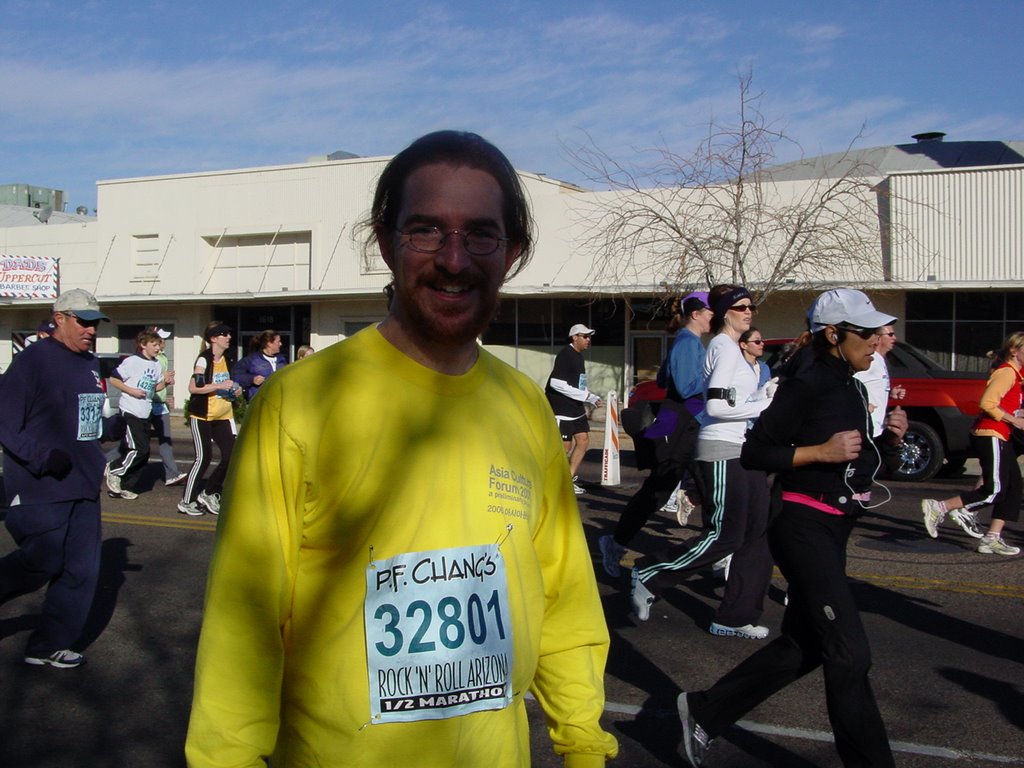
Ran the Valley of the Sun 1/2 marathon this morning. Very early this morning. Had to get up at 3am in order to get ready and drive all the way to the edge of town to the race’s staging area near the Usery Mountain park and recreation area. It was beautiful (actually, when I got there, it was very very dark). The race started at 6:15, just as the sun was rising over the desert. I was a bit worried about this race, since my training has been really spotty since the semester started and the last long run I took (10 miles a couple of weeks ago) ended in great pain (the knees, ow). But it went OK, though there were a few hills (some long ones, too). I finished the Rock and Roll ½ marathon in january in 2 hours and 10 minutes about; this one I finished in 2:01:49, so 9 minutes faster. I took 310th place (woo hoo!) and 37th in my division, which I think is age group. And the knees held up.

It’s interesting what people discuss with each other during these long runs. They’re not talking to me, just happen to be on the same pace and nearby; and some people’s voices carry, even when running a half marathon. During part of the January race I was treated to a discussion about someone’s relationship; today I got a half hour of how one person was going to re-do their landscaping and how expensive desert plants from nurseries were these days after the big freeze in January. But a couple of people were talking about the PF Chang run, and reminded me of something I forgot to blog about when I described that run. Over the course of the first two miles or so of that race, there were a number (over a half-dozen) people on the sidewalks holding these huge signs with biblical verses from Revelations and bold warnings that we (presumably the thousands of people trotting down the road) were all on the road to hell (“actually,” someone nearby quipped, “I thought this was the road to Tempe”). It was an interesting way to start a race. No signs today, just lovely saguaro cacti and pretty mountains (and the edge of the ‘burbs cutting into the desert).

Saturday, March 03, 2007

minivan

Always swore that I'd never buy a minivan.
Never conceived that I'd own a vehicle with leather seats.
And am very wary of built in DVD systems in vehicles.

But with the pragmatics of ferrying small children and their friends thither and yon, the larger vehicle makes sense (seats more people, more car seats). The leather and DVD player just happened to be there, though we weren't looking for them when we were scoping new wheels.

But what prompted such a purchase was the final failure of our ever-faithful 1995 honda civic hatchback (178,000 miles). We loved that car and have driven it across the country, commuted from Georgia to South Carolina in it (cf. the opening of my "home" essay; that's the car). Over the last two years it's been stolen and returned (as part of a police sting operation on a ring of honda thieves no less), wrecked and fixed. Put a new A/C system in it last Spring ($2K) and a new clutch two weeks ago (and new tires last month). But something caused it to overheat, the head gasket blew, the engine fried, and we were looking at way too much money to get it fixed again. But someone who loves those cars bought it and will fix it up so that it may finally make that 200K miles we wanted it to make.

So now we have a 2003 Honda Odyssey in great condition with only 38,000 miles (perhaps they only drove it on weekends?). Not looking forward to having to fill this thing up with gas. But it's a great vehicle.

Friday, February 23, 2007

more on backscatter

New York Times on the launch of backscatter at Sky Harbor (need site registration and allow cookies): http://www.nytimes.com/2007/02/24/us/24scan.html

I went through one of the puff machines they mention in the article at the San Francisco airport last Fall, which was interesting. I'm not interested in volunteering for backscatter.

Wednesday, February 21, 2007

Backscatter X-rays

Our romantically named Sky Harbor airport has been promising to pilot new back-scatter x-ray technology (labelled "the virtual strip-search" by the ACLU) at security checkpoints. The roll-out has been delayed for a while, but it looks like it's back on track and will be operational this weekend.
The Arizona Republic Story: http://www.azcentral.com/news/articles/0221backscatter-ON.html
I've only had the chance to glance quickly at the many responses to the article linked on the website above, but they seem to run the usual gamut of "it's about time, we need to be safe," to "I have nothing to hide, so why should I worry," to "it's a neo-con plot!!" (these are paraphrases, of course).

EPIC (Electronic Privacy Information Center)'s page on backscatter technology:
http://www.epic.org/privacy/airtravel/backscatter/

And the TSA's (Transportation Security Administration) page on privacy and backscatter:
http://www.tsa.gov/research/privacy/backscatter.shtm

Remarkable difference in the level of detail available in the images between the EPIC article (drawing on older reports, presumably) and how the TSA supposedly have tweaked it to reduce the invasion of privacy (down to chalk outlines). One wonders that, given that they're actually doing this, will it actually detect anything useful, and will it detect anything that couldn't be detected by other less intrusive means? It seems to be a solution looking for a problem, another technophilic fix to the problem of security (see David Lyons' Surveillance After September 11; Blackwell).

There's been some concern by the ACLU and others about the fate of these images (who has access, can they be stored, could they end up on the Internet, etc.) According to the TSA (FWIW)--see above link and their link to their FAQ on privacy, scroll to the bottom for backscatter: http://www.tsa.gov/research/privacy/faqs.shtm --

"Images will not be printed, stored or transmitted
To further enhance privacy, when the Transportation Security Officer has resolved any anomaly, the image is erased from the screen. The capability of printing, storing or transmitting the image is not available to the Transportation Security Officer operating the system."

Note that this doesn't say that these images can't be printed, stored, or transmitted, just that the Officer monitoring them can't do this. And note also that the image is erased (passive voice; by whom?) "from the screen." Is it erased from the computer itself? Pick pick pick.

[EDIT: one last thing, almost all of this debate is framed in terms of privacy--which seems obvious since we're talking about taking x-rays of people which see through their clothes. But, again following some of David Lyons' thinking about surveillance, we also need to think this through in terms of other issues, like dignity (a human right according to the UN), and this whole thing certainly seems undignified.

Thursday, February 15, 2007

CSPO

Just became an affiliate faculty member of the Consortium for Science, Policy & Outcomes, a unit run out of the College of Liberal Arts and Sciences of ASU down in Tempe. Seems an interesting group of folks, lots of potential for collaboration at some point. I'll be presenting a brown-bag lecture down there later this Spring just as a means of introduction. CSPO is also affiliated with the Center for Nanotechnology in Society, and nanotech has been a long-time interest of mine (though I've never had the opportunity to write about it yet).

Sunday, February 11, 2007

5K

Just ran my first 5K in donkey’s years. After the half marathon the 3.1 miles should be a piece of cake, but a 5K is more about strength and speed than endurance. Anyway the run kinda sucked (well, my run did, the entire event—The Year of the Boar 5K Run and Wok—was a convivial and efficient, though relatively small, affair). Not sure what went wrong. First mile was fast-ish (7:16, which is fast for me these days), but hit something like a bloodsugar drop on the second mile and lost energy (hit mile 2 in 15 minutes, so not too much slower), which led to general nausea in the third mile (fun, eh?). So I ended up with a 24:00 5K and still managed to win my age group (!). Which goes to show both that it pays to be over 40 and also how small an event this was.

Now, 24 minutes is a pretty decent time. But I’m also realizing as I do more of these events that my only yardstick of success for distance running—and hence my real competition—is what I did when I was 18. I know, I know: competing with oneself is such a cliché. But I also have this nagging feeling that I can actually beat him (that is, me, or the 18-year old me): I’m handling distances much more easily than I did when I was younger. I should point out that when I was 18, I wasn’t that great a runner and never made varsity in either track or cross-country, so it’s not like I’m setting the bar all that high here.

Tuesday, February 06, 2007

New books

Looks like I need to find a new phrase to begin my blog posts :)

Two new books:
David Harvey, A Brief History of Neoliberalism (Oxford)
Manuel DeLanda, A New Philosophy of Society: Assemblage Theory and Social Complexity (Continuum).

The latter has me wondering about what seems to be a sudden recent interest in Deleuze's (and D&G's) notion of assemblage. I have a vested interest in this, of course, having written a chapter in Charles Stivale's Gilles Deleuze, Key Concepts book on Assemblage and using it in my own work on technology (first in Exploring Technology and Social Space, and then more extensively in Jennifer and my Culture and Technology: A Primer). But there's not only DeLanda's new book and essay ("Deleuzian Social Ontology and Assemblage Theory" in Fuglsang and Sorensen's Deleuze and the Social) and his previous book, Intensive Science and Virtual Philosophy, but three separate essays on assemblage in last year's Theory, Culture and Society's mammoth special issue on Problematizing Global Knowledge. Also the term comes up in the title of Ong & Collier's edited collection, Global Assemblages: Technology, Politics, and Ethics as Anthropological Problems (Blackwell), though it's really not developed at all in the collected itself.

Anyway, I'm interested to read at least the first couple chapters of DeLanda's book, his explication of assemblage. I'm more wary of the latter chapters applying the theory to society and social problems, especially after the entry in The Pinocchio Theory blog on the book and an excellent but as yet unpublished essay by Steven D. Brown on Deleuze and social science which I just got the chance to read.

Wednesday, January 24, 2007

Copenhagen, part II

Looks like I'll also be making a presentation that same trip to Copenhagen University, courtesy of the Anthropology Department (thanks to Kare Jansbol for the invite!). It'll be a more general talk on Deleuze and Technology, that Thursday afternoon (May 10th).

Friday, January 19, 2007

Copenhagen

Looks like I'm going to Copenhagen in May. I've been invited to participate in a short, intense PhD seminar at the IT University of Copenhagen along with Adrian Mackenzie, Casper Bruun Jensen, and Steve Brown. The website for the course is here: http://www1.itu.dk/sw55657.asp in case anyone knows of any PhD Students who would be interested in taking the course. It's on Deleuze, Technology, and Ethnograpy. My thanks to Soren Mork Petersen for the invite.

In any case, I'm looking forward to it. Need to start working on my presentation, most likely something around Deleuze, technology, assemblage, attention, and ubiquitous computing (everyware) which I'm hoping to turn into either a long essay or a short book (though all my plans for long essays always turn into very short essays for some reason).

Now, if I could get that Danny Kaye song out of my head, I could think things through more clearly :)

Monday, January 15, 2007

More on the half-marathon

This is me between miles 4 and 5 having just dropped off my jacket, hat, and gloves with Elise. Only 8 or 9 miles to go! Note the Asia Culture Forum T-Shirt (see previous postings in this here blog).

Sunday, January 14, 2007

Half Marathon

Just a quick blog. This morning I ran the PF Chang’s Rock and Roll Half Marathon here in Phoenix. I’ve only run a race close to this distance (a 20K) once, and that was back in the first Reagan administration. For some reason I’ve been able to sustain these longer runs over the last few months (ah, sabbatical). In any case, 13.2 miles is my longest race, and probably my longest run. I was looking to finish, hoping to hit a pace of about 10 minutes a mile, and ended up just about there, finishing in 2:10:45 (which would be a world class time—in the marathon). So I’m happy.

It was coooooold today in Phoenix—lows in the mid 20’s F and temps perhaps at the mid-30s at race time. I started slow, taking it easy, and seeing how the whole thing felt. Actually ended up taking a pit stop at the portable johns at the first mile mark since they kept us standing at the start in the cold for over 45 minutes, and I had been drinking lots of coffee. But after about 6 miles or so I felt pretty good and started picking up the pace, and from then on basically ran negative splits (each mile faster than the previous). Ended up feeling really great over the last 3 miles. I’ll post pictures when I get them.

There were over 37,000 registrants for both the marathon and half-marathon today, not sure how many stayed home because of the cold, but there were tens of thousands of people out there on the course today. Runs are usually fairly festive events, but this one prides itself on its entertainment—bands (mostly rock—and if I hear “Born to be Wild” one more time….You think these bands would know another song) every other mile or so, cheering squads along the route. What I do like about road racing (and this was my first road race since….um….the second Reagan administration, perhaps the first Bush admistration) is that transgressive feeling you get running down the middle of the street (where only cars are supposed to go) ignoring all the stop signs and stoplights.

Anyway, I’m sleepy, my feet are tired, and my knees ache.
But there’s another ½ marathon down in Mesa in two months…